

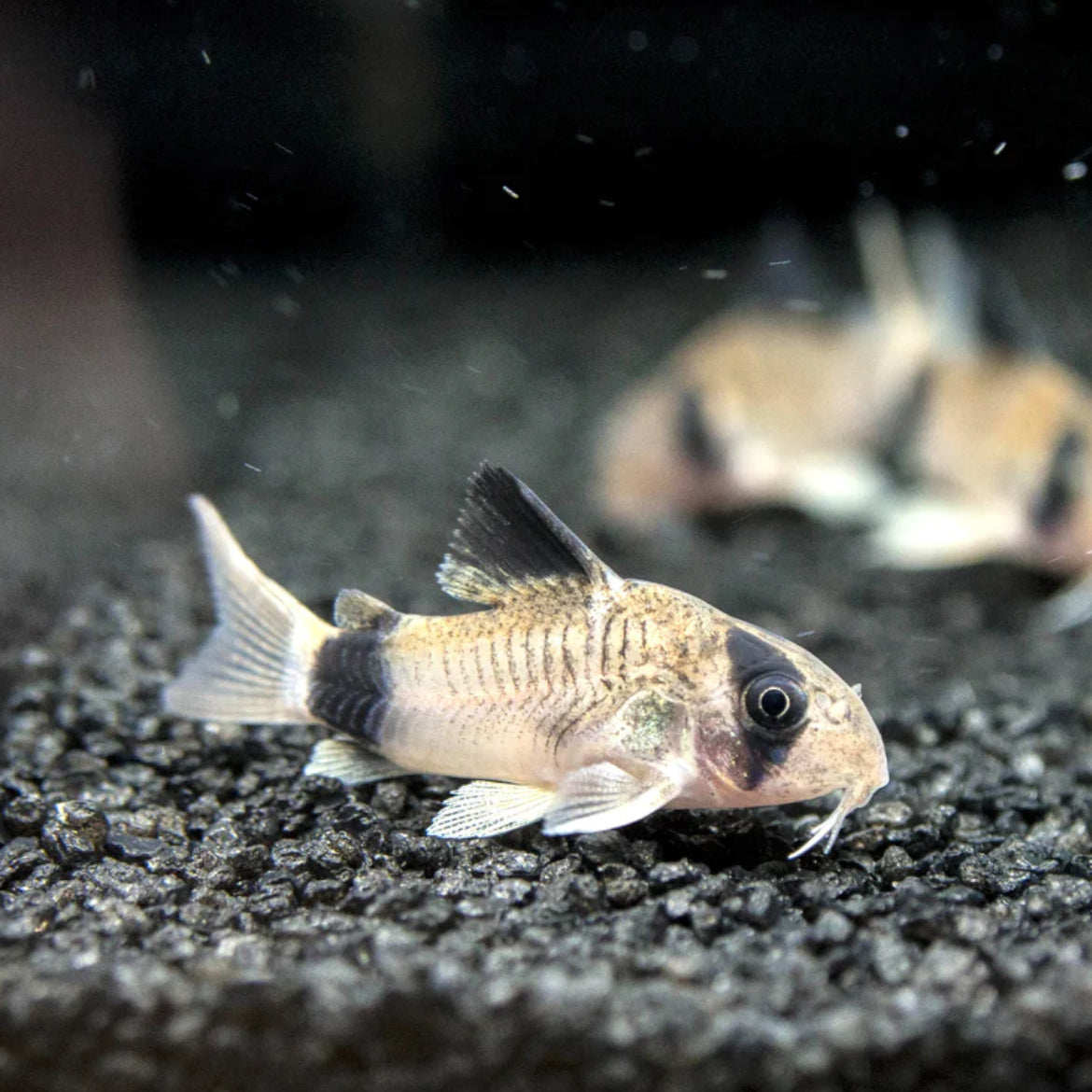
Panda Cory Catfish are one of the most recognizable bottom-dwelling fish in the freshwater aquarium hobby. Their black eye patches, dark dorsal markings, pale body, peaceful temperament, and social behavior make them especially appealing in planted community tanks.
But the best reason to keep Panda Corys is not that they are a “cleanup crew” or that they can be squeezed into any small aquarium. They are active, social catfish that do best when kept in an appropriately sized group, given a soft or smooth substrate, fed a complete diet, and provided with stable water conditions.
If you are looking for Panda Cory Catfish for sale, check current Panda Cory Catfish availability at Shrimp Up Aquatics. Our current listing offers group sizes of 3, 6, 12, and 18 fish.
What Is a Panda Cory Catfish?
The Panda Cory Catfish, Corydoras panda, is a small South American armored catfish native to the upper Amazon basin. Its name comes from the dark markings around the eyes and near the tail that resemble the contrasting pattern of a giant panda.
FishBase lists Corydoras panda as a freshwater, bottom-oriented species from the upper Amazon River basin and reports a maximum standard length of about 3.8 cm. In aquariums, they are commonly described as roughly 1.5–2 inches once mature.
Unlike fish that spend most of the day cruising open water, Panda Corys spend much of their time investigating the lower portion of the aquarium, moving across substrate, resting under plants, and searching for food.
Why Are Panda Corys So Popular?
Panda Corys combine several characteristics that make them unusually easy to enjoy in a community aquarium:
- Distinctive black-and-cream coloration
- Peaceful behavior
- Strong social tendencies
- Constant bottom-level activity
- Manageable adult size
- Compatibility with many planted community setups
They also behave very differently from typical midwater schooling fish. A group of Corydoras can spend one moment resting together beneath a plant and the next moving as a group across the substrate.
That gives the lower third of the aquarium activity without adding an aggressive or territorial fish.
Panda Corys Are Social Fish—Keep Them in a Group
Corydoras should not be treated as solitary bottom cleaners.
Research on Corydoras social behavior has repeatedly documented strong group cohesion and social interaction. A study available through PubMed Central describes Corydoras as highly gregarious catfish and examined how social experience changes their group behavior.
A broader Corydoras husbandry protocol published in a peer-reviewed research setting also notes that many Corydoras species form large aggregations and display obvious social behavior in captivity.
For a home aquarium, six or more Panda Corys is a much better target than keeping one or two alone.
If you already own a partial group, the smaller pack options on the Panda Cory product page can be useful for expanding an existing school. If you are starting from zero, the 6-fish option is the more natural starting point.
Panda Cory Tank Size: Use a 20-Gallon Aquarium or Larger
Panda Corys are small, but they are active bottom fish that should be kept in groups. Floor space matters just as much as total water volume.
The current Shrimp Up Aquatics Panda Cory listing recommends a minimum tank size of 20 gallons. That is a better recommendation than treating Panda Corys as true micro-fish for extremely small nano tanks.
A 20-gallon long is especially attractive because the longer footprint provides more substrate area for a group to explore.
If your goal is a much smaller nano aquarium, a different species may make more sense. Pygmy Cory Catfish stay smaller and are a better Corydoras option when you are deliberately building around a compact tank.
For more general small-tank planning, our nano aquarium setup guide explains why smaller water volumes require extra attention to stability.
Panda Cory Water Parameters
The current Shrimp Up Aquatics Panda Cory product page recommends:
| Parameter | Recommended Range |
|---|---|
| Temperature | 72–82°F |
| pH | 5.8–7.8 |
| KH | 0–15 dKH |
| Minimum Tank Size | 20 gallons |
FishBase lists a natural temperature range around 20–25°C and a broad pH range around 6.0–8.0. Rather than chasing one exact number, focus on keeping the aquarium stable within a suitable range and avoiding sudden temperature or chemistry swings.
Ammonia and nitrite should remain at zero in an established aquarium.
Use Fine Sand or a Smooth Substrate
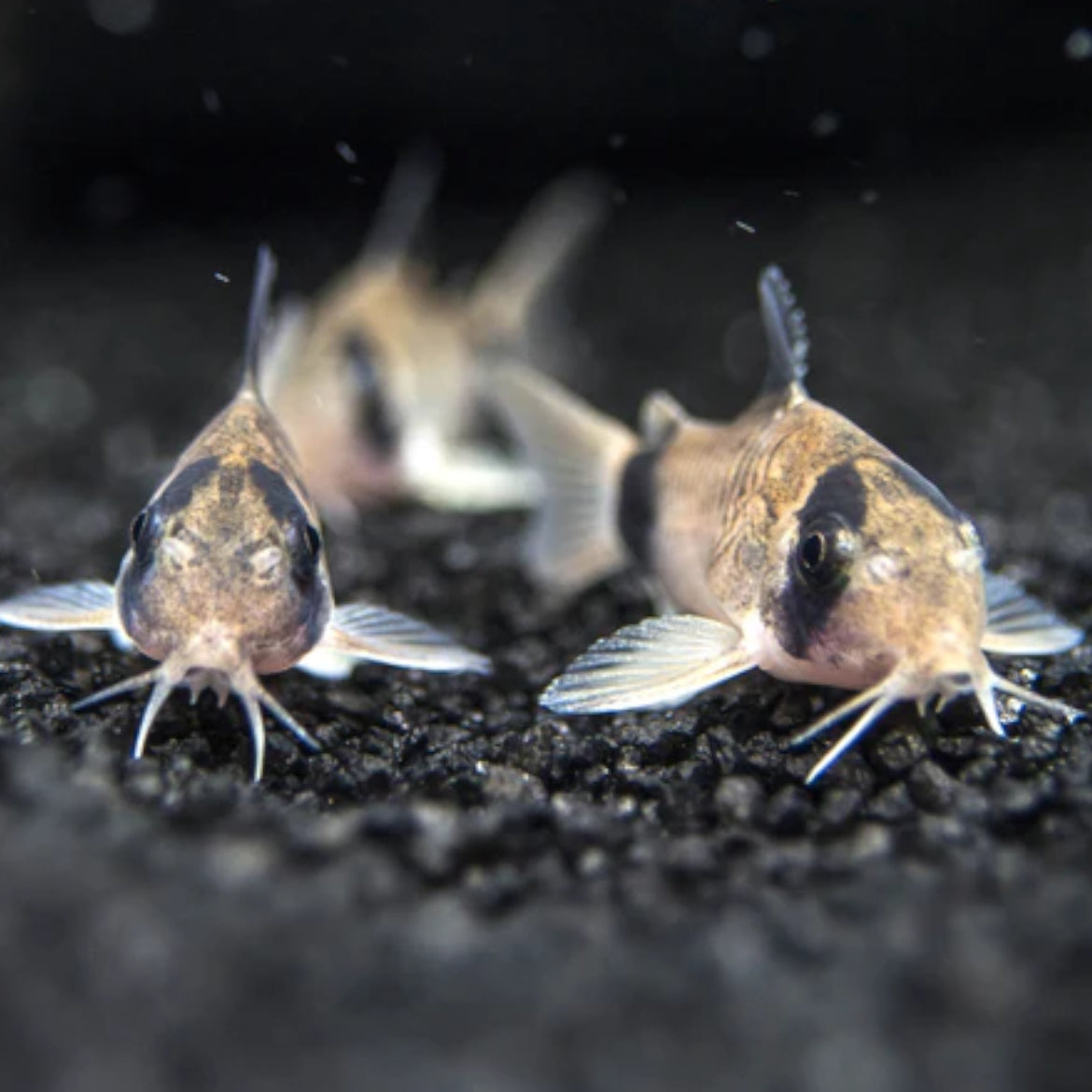
Panda Corys forage by moving their snouts and sensitive barbels across the bottom of the aquarium.
A comprehensive Corydoras husbandry protocol describes Corydoras as benthic, social feeders that use their barbels while foraging through substrate for food.
That makes substrate choice important.
Fine sand is an excellent option because the fish can naturally sift and search without repeatedly scraping across sharp edges. Smooth, rounded fine gravel can also work when it does not damage the mouth or barbels.
Avoid jagged, abrasive substrate.
Also keep the bottom reasonably clean. Poor water quality and accumulated organic waste around the substrate can contribute to health problems even when the substrate itself is smooth.
What Do Panda Cory Catfish Eat?
Panda Corys are omnivorous bottom feeders, but they should not be expected to survive on scraps that happen to fall past your other fish.
They need a complete diet of their own.
Useful foods include:
- Quality sinking catfish or community-fish pellets
- Sinking wafers
- Frozen or live foods such as bloodworms or similar appropriately sized foods
- Small protein-rich foods that reach the substrate
- A varied prepared diet rather than one food exclusively
Watch the fish at feeding time. In a busy community tank, faster midwater fish may consume most of the food before it reaches the Corys.
Feeding after lights dim slightly, distributing food in multiple areas, or using sinking foods can help ensure the entire group eats.
Panda Corys Are Scavengers—Not Aquarium Janitors
The older version of this article leaned too heavily on the idea that Panda Corys “clean” the tank.
That needs context.
Panda Corys will absolutely search the substrate for edible material and leftover food, but they do not remove waste from the aquarium system. Food they eat still becomes fish waste later.
They are also not specialist algae eaters.
Do not buy Panda Corys because you want them to solve an algae problem or replace substrate maintenance.
Buy them because you want a social, active bottom-dwelling fish—and appreciate the fact that their natural foraging behavior helps them find edible food that reaches the bottom.
Best Tank Mates for Panda Cory Catfish
Panda Corys are peaceful and generally work best with other non-aggressive freshwater livestock that prefer overlapping water conditions.
Potential tank mates include:
- Small rasboras
- Peaceful tetras
- Other appropriately sized Corydoras
- Peaceful dwarf fish
- Adult freshwater shrimp
- Freshwater snails
Avoid large, territorial, or predatory fish that can harass or swallow them.
You can browse additional options in our freshwater nano fish collection, but always compare adult size and tank requirements before combining species.
Can Panda Corys Live With Freshwater Shrimp?
Adult Neocaridina and Panda Corys are often kept in the same peaceful planted community aquarium when their water requirements overlap.
But no fish should be treated as completely safe for newborn shrimp.
A tiny shrimplet that fits into a fish's mouth may be eaten opportunistically, even if the fish is not an aggressive predator.
If your goal is maximum shrimp reproduction, a shrimp-only aquarium is still safer.
If you specifically like blue Neocaridina as community companions, our Blue Dream Shrimp aquarium guide explains their care, planted-tank setup, and community considerations.
If your goal is a mixed display with adult shrimp and Corydoras, provide dense moss, plants, wood, and other structure.
For shrimp-specific husbandry before building that combination, our Beginner's Guide to Keeping Neocaridina Shrimp explains the shrimp side of the setup.
Why Panda Corys Work So Well in Planted Aquariums
Plants give Panda Corys visual cover without removing the open substrate they need for foraging.
A good planted Cory tank can combine:
- Open sand along the front or center
- Dense plants toward the back and sides
- Driftwood or smooth rock for structure
- Shaded resting areas
- Open feeding zones where the group can gather
The trick is not to cover every square inch of substrate. Panda Corys benefit from open bottom space.
Our aquascaping guide is written around shrimp tanks, but its sections on plant placement, open foregrounds, hardscape, and substrate planning translate well to peaceful planted community aquariums.
If you need live greenery for the setup, browse our live aquarium plants.
Panda Corys Have Fascinating Air-Breathing Behavior
Do not be surprised if a Cory suddenly rockets to the surface, takes a gulp of air, and immediately returns to the bottom.
Corydoras have the ability to use atmospheric air as an accessory source of oxygen. FishBase specifically lists Corydoras panda as a facultative air-breathing species.
Research on other Corydoras species has explored this behavior in detail. A study published through PubMed Central examined how oxygen conditions, temperature, and group dynamics influence air-breathing behavior in bronze Corydoras.
An occasional rapid trip to the surface can therefore be normal Cory behavior.
However, repeated frantic surface visits by the entire tank should still prompt you to check oxygenation, temperature, ammonia, nitrite, and overall water quality.
Panda Cory vs. Pygmy Cory: Which Should You Choose?
Both are peaceful Corydoras, but they fill different roles.
Panda Cory:
- Larger-bodied
- More strongly bottom-oriented
- Bold black-and-white markings
- 20-gallon minimum on the current Shrimp Up Aquatics listing
Pygmy Cory:
- Much smaller
- Uses midwater more often than most Corydoras
- Better fit for intentionally small nano-style setups
- Current Shrimp Up Aquatics listing recommends groups of 6+
If you want the classic bottom-foraging Cory experience and have enough floor space, Panda Corys are an excellent choice. If tank size is the main constraint, Pygmy Corys deserve serious consideration.

Panda Cory vs. Sterbai Cory
If you have a warmer or larger community aquarium, Sterbai Corys are another excellent species to compare.
Sterbai Cory Catfish have a darker body covered with pale spots and distinctive orange coloration in the fins. Visually, they produce a very different effect from Panda Corys.
Choose Panda Corys when you want the classic pale body with bold black patches. Choose Sterbai when you prefer spotted patterning and a more dramatic darker appearance.

Are Panda Cory Catfish Good for Beginners?
Yes—provided the beginner understands three things:
- They need a group. Do not buy one fish as a solitary cleaner.
- They need their own food. Leftovers are not a complete feeding plan.
- They need an established tank. A hardy reputation does not make ammonia or nitrite safe.
Once those basics are handled, Panda Corys are peaceful, entertaining, and relatively straightforward community fish.
How to Acclimate Panda Cory Catfish
When new fish arrive, avoid moving them immediately from shipping water into aquarium water with substantially different temperature or chemistry.
Temperature-acclimate the unopened bag first, then gradually introduce tank water using the acclimation method appropriate for your shipment and system.
Once the fish are transferred, keep lighting subdued and give them time to settle.
For fish purchased from Shrimp Up Aquatics, review the current shipping and live-arrival requirements on the Panda Cory product page before ordering, since fish shipping requirements can differ from shrimp orders.
Can Panda Cory Catfish Breed in an Aquarium?
Yes. Healthy mature Corydoras can reproduce in captivity under suitable conditions.
Breeding is not guaranteed simply because males and females are present, but conditioned adults may spawn and attach eggs to aquarium surfaces.
If breeding is your goal, a dedicated setup gives you far more control over egg survival, feeding, and water quality than a busy community aquarium.
Common Panda Cory Care Mistakes
Keeping Only One or Two
Corydoras are social fish. Build a real group rather than treating them as solitary catfish.
Using an Abrasive Substrate
Sharp substrate can interfere with natural bottom-foraging behavior and may damage sensitive barbels.
Assuming They Live on Leftovers
Panda Corys need a complete diet. Feed them intentionally.
Putting Them in an Undersized Tank
The current Shrimp Up Aquatics Panda Cory page recommends a 20-gallon minimum. Their group behavior and bottom activity require usable floor space.
Treating Them as Algae Eaters
Panda Corys are scavenging omnivores, not specialist algae-control fish.
Ignoring the Bottom of the Tank During Maintenance
Because they live and feed near the substrate, accumulated debris and poor bottom-level water quality matter.
Keeping Them With Aggressive Fish
Choose peaceful community tank mates that will not harass, outcompete, or swallow them.
Panda Cory Catfish FAQ
How big do Panda Cory Catfish get?
FishBase reports a maximum standard length around 3.8 cm, while aquarium hobbyists commonly describe adults as roughly 1.5–2 inches overall.
How many Panda Corys should be kept together?
A group of at least six is a practical target because Corydoras are highly social fish. Larger groups can display even more natural activity when tank size allows.
Can Panda Corys live in a 10-gallon tank?
The current Shrimp Up Aquatics Panda Cory listing recommends a 20-gallon minimum. If you specifically want a Cory for a smaller tank, Pygmy Corys are the better species to investigate.
Do Panda Corys eat algae?
They may pick at edible material while foraging, but they are not specialist algae eaters. Feed them a proper sinking omnivore diet.
Can Panda Corys live with shrimp?
They can often coexist with adult freshwater shrimp in peaceful planted aquariums when their water needs overlap, but tiny shrimplets may still be eaten opportunistically.
Do Panda Corys need sand?
Fine sand is an excellent choice because it supports their natural substrate-sifting behavior. Smooth fine gravel can also work when it is not abrasive.
Why do Panda Corys swim to the surface?
Corydoras are facultative air breathers and can make quick trips to the surface for air. Occasional surfacing is normal, but excessive surface activity should trigger a water-quality and oxygen check.
Are Panda Corys peaceful?
Yes. They are generally gentle community fish and are best paired with other peaceful species.
Why Panda Corys Are Such a Great Community Fish
Panda Cory Catfish earn their popularity because they add something genuinely different to a freshwater aquarium.
They bring bold black-and-white patterning, social group behavior, constant bottom-level activity, and a peaceful temperament without dominating the rest of the tank.
The key is giving them what they actually need: a real group, a 20-gallon-or-larger aquarium, smooth substrate, a complete sinking diet, clean water, and peaceful tank mates.
Do that, and Panda Corys become far more than a “cleanup crew.” They become one of the most entertaining fish in the aquarium.
Ready to add a group? check Panda Cory Catfish availability at Shrimp Up Aquatics and choose the group size that fits your existing school and aquarium.
If you want to compare other peaceful fish before deciding, browse our freshwater nano fish collection.
Sources & References
FishBase — Corydoras panda — Species classification, freshwater habitat, distribution, size, temperature range, pH range, and facultative air-breathing status.
Comprehensive Husbandry Protocol for Corydoras Catfish — Peer-reviewed husbandry resource covering Corydoras sociality, bottom-foraging behavior, feeding, and aquarium care.
Ecology and Evolution — Developmental Social Experience in Corydoras — Research on social behavior, group cohesion, and social experience in Corydoras catfish.
Journal of Fish Biology — Social Dynamics and Air Breathing in Corydoras — Research examining group air-breathing behavior and the effects of oxygen conditions in Corydoras.