

Blue Dream Shrimp are one of the most eye-catching freshwater shrimp you can add to a planted aquarium. Their deep navy-to-electric-blue coloration creates dramatic contrast against green plants, dark wood, light stone, and natural aquarium décor, while their peaceful behavior and relatively easy Neocaridina care make them accessible to both new and experienced shrimp keepers.
They are not just decorative. Blue Dream Shrimp spend much of the day grazing across plants, wood, rocks, substrate, filter sponges, and aquarium glass. They are small enough for nano tanks, peaceful enough for carefully selected community setups, and capable of reproducing entirely in freshwater when conditions are stable.
If you are looking for Blue Dream Shrimp for sale and want to start with healthy breeding-age Neocaridina, shop Blue Dream Shrimp from Shrimp Up Aquatics. Our current listing offers individual shrimp, 5-, 10-, and 20-shrimp packs, plus a breeder-pack option for hobbyists who want to start a colony.
What Are Blue Dream Shrimp?
Blue Dream Shrimp are a selectively bred blue color variety of Neocaridina davidi, the same freshwater shrimp species behind many popular Cherry, Yellow, Orange, Green, Rili, and other ornamental Neocaridina lines.
The defining feature is their blue coloration. High-quality individuals can range from medium blue to deep navy, with some shrimp showing extremely intense pigment across most of the body.
Because they are Neocaridina, their fundamental husbandry is similar to other common Neocaridina color morphs. They do best in a mature, fully cycled aquarium with stable minerals, gentle filtration, abundant biofilm, and consistent maintenance.
The University of Florida IFAS profile for Neocaridina davidi describes these shrimp as detritivores and opportunistic feeders that graze on algae, biofilms, and dead organic material. It also notes their direct development, meaning young hatch as miniature shrimp instead of passing through a free-swimming larval stage.
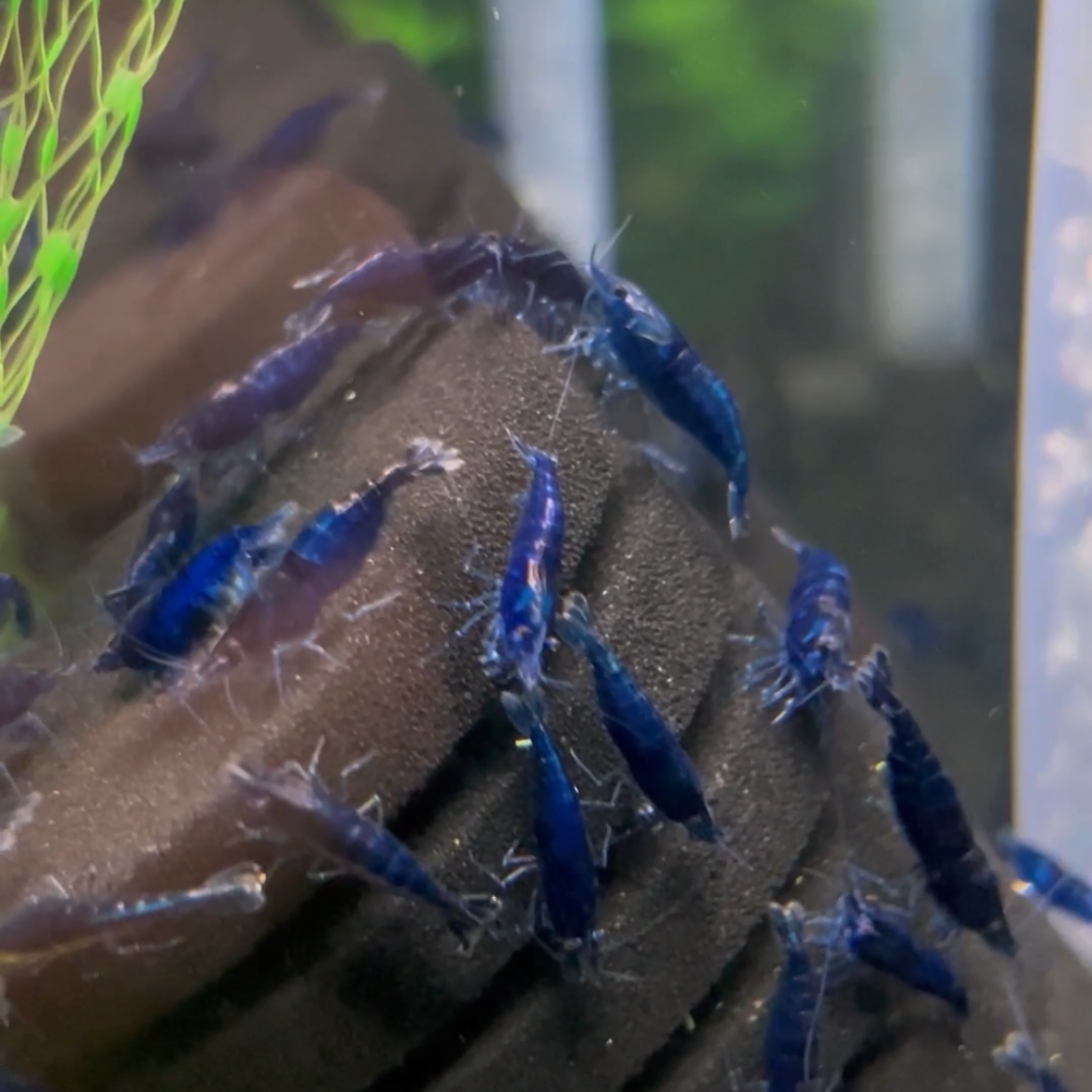
1. Blue Dream Shrimp Have Exceptional Color
The biggest reason people fall in love with Blue Dream Shrimp is obvious: the color.
Deep blue is relatively uncommon in freshwater aquarium livestock, especially in animals this small. A healthy Blue Dream colony can create a completely different visual effect from the more common red, orange, or yellow shrimp tanks.
The color becomes especially dramatic when the aquascape is designed around it.
Blue Dream Shrimp look excellent against:
- Bright green moss
- Java Fern
- Anubias
- Light stone
- Natural driftwood
- Open foreground areas
- Dark backgrounds with enough plant contrast
If the aquarium is extremely dark from front to back, deep blue shrimp can visually disappear. A few bright green or lighter hardscape elements can make the blue pigment stand out much more clearly.
Our Neocaridina Shrimp Tank Aquascaping Guide explains how substrate, plant color, hardscape, and layout can make different shrimp colors more visible.
2. They Are Beginner-Friendly Compared With Many Specialty Shrimp
Blue Dream Shrimp look like premium specialty livestock, but they do not require the specialized soft-water setup associated with many ornamental Caridina varieties.
That makes them an excellent bridge between beginner shrimp keeping and a more visually dramatic display tank.
Our current Blue Dream systems at Shrimp Up Aquatics are maintained around:
| Parameter | Our Blue Dream Systems |
|---|---|
| pH | 7.0–7.8 |
| GH | 7–8 dGH |
| KH | 3–4 dKH |
| TDS | 200–250 ppm |
| Temperature | 65–74°F |
| Ammonia | 0 ppm |
| Nitrite | 0 ppm |
Your aquarium does not need to match those numbers perfectly to the decimal. The key is maintaining appropriate conditions consistently instead of repeatedly changing the water chemistry.
If you want a deeper explanation of GH, KH, pH, TDS, and temperature, read our Neocaridina Shrimp Water Parameters Guide.

3. Blue Dream Shrimp Are Constant Grazers
Blue Dream Shrimp spend much of their time picking at microscopic food growing across aquarium surfaces.
In a mature tank, they naturally graze on:
- Biofilm
- Soft algae
- Microorganisms
- Fine organic debris
- Decaying plant material
This makes them active participants in the aquarium ecosystem rather than animals that simply sit on display.
You may see them grazing upside down beneath plant leaves, climbing sponge filters, walking across driftwood, picking through moss, or gathering around a feeding dish.
They should not be marketed as a replacement for aquarium maintenance. Blue Dream Shrimp still produce waste, and they cannot compensate for excessive feeding, poor filtration, or severe nuisance algae.
But as continuous grazers in a mature planted tank, they add both visual activity and ecological function.
4. They Are Excellent for Planted Aquariums
Blue Dream Shrimp and live plants are a particularly strong combination.
Plants create enormous amounts of usable shrimp habitat without requiring more floor space. Every leaf, stem, root, and moss strand can become a grazing surface as the aquarium matures.
Plants also provide:
- Cover after molting
- Protection for newborn shrimplets
- More biofilm surface
- Visual contrast with blue coloration
- Additional structure throughout the tank
Dense green moss is especially useful if breeding is your goal because tiny shrimplets can remain protected while feeding on microscopic material.
5. Blue Dream Shrimp Fit Nano Aquariums Extremely Well
Because adult Neocaridina stay small and use surfaces rather than long open swimming lanes, Blue Dream Shrimp are excellent livestock for compact planted aquariums.
A properly cycled 5-gallon tank can work, while a 10-gallon aquarium is often even easier for beginners because the larger water volume changes more slowly.
The important distinction is that nano tanks are physically well suited to shrimp but not automatically easier to maintain.
In a small aquarium:
- Temperature changes faster.
- Overfeeding has a larger impact.
- Evaporation changes water chemistry faster.
- A small maintenance mistake affects a larger percentage of the tank.
That is why stability still matters.
6. Blue Dream Shrimp Breed Entirely in Freshwater
One of the most rewarding parts of keeping Blue Dream Shrimp is watching a colony grow.
Mature females carry eggs beneath the abdomen until miniature shrimplets hatch. There is no brackish larval stage required.
That means a healthy starter group can eventually develop into a multi-generation colony containing adults, juveniles, berried females, and tiny newborn shrimp.
The easiest way to encourage natural reproduction is not to constantly interfere with the aquarium.
Provide:
- Stable water chemistry
- Mature biofilm
- Moss and plants
- Shrimp-safe filtration
- Appropriate nutrition
- Low predation
If breeding is your main goal, the live Blue Dream Shrimp product page currently offers a 10-shrimp breeder pack designed with a planned ratio of 7 females and 3 males.
For a full colony-building walkthrough, see our Complete Neocaridina Shrimp Breeding Guide.

7. A Single-Color Blue Dream Colony Can Stay Visually Consistent
If maintaining strong blue coloration matters to you, keep Blue Dream Shrimp in their own breeding tank.
Different Neocaridina color varieties can interbreed. Mixing Blue Dream with red, yellow, orange, green, or Rili lines can produce unpredictable offspring and may eventually create more translucent, brown, or wild-type coloration.
A mixed-color aquarium is perfectly fine if that is the look you want.
But if your goal is to build and maintain a recognizable Blue Dream line, keep the colony separate from other Neocaridina color strains.
8. They Are Peaceful Aquarium Inhabitants
Blue Dream Shrimp are peaceful toward other shrimp, snails, and fish.
The larger concern is whether the fish are peaceful toward the shrimp.
Even small fish may eat newborn shrimplets. Larger fish may eat adult shrimp.
If maximum breeding success is the goal, a dedicated shrimp-only aquarium is the simplest option.
In a community tank, dense plants, moss, wood, and other cover can improve survival, but they cannot completely eliminate predation.
9. They Are Fun to Watch
Blue Dream Shrimp are surprisingly active when comfortable.
A healthy colony rarely sits still for long. Individual shrimp constantly move between grazing areas, and the smaller scale of a shrimp tank makes those behaviors easy to observe.
You may see:
- Females carrying eggs
- Males swimming after a female molts
- Juveniles grazing in moss
- Shrimp gathering around food
- Fresh molts on the substrate
- Adults climbing plants and filter sponges
That constant small-scale movement makes a Blue Dream aquarium feel alive even without fish.
10. They Give You Premium Color Without Premium-Level Difficulty
This is where Blue Dream Shrimp stand out most strongly.
You get a dramatic specialty color while keeping the relatively approachable care of Neocaridina.
Many premium ornamental Caridina can display extraordinary blue coloration too, but those shrimp often require soft water, low KH, active substrate, and more controlled water preparation.
Blue Dream Shrimp give hobbyists a way to build a visually striking blue colony without immediately moving into that more specialized style of shrimp keeping.
What Size Blue Dream Shrimp Does Shrimp Up Aquatics Sell?
Our current Blue Dream Shrimp listing shows shrimp at approximately 1/2 to 1 inch and breeding age.
Available options currently include:
- 1 Shrimp
- 5 Shrimp
- 10 Shrimp
- 20 Shrimp
- 10-Shrimp Breeder Pack
For someone who wants a display colony, the regular packs make it easy to choose the group size that fits the aquarium.
For someone focused on breeding, the breeder pack is specifically structured around a planned female-heavy ratio.
How to Set Up a Blue Dream Shrimp Tank
A simple Blue Dream setup can be extremely effective.
| Tank Element | Recommended Approach |
|---|---|
| Tank | 5–10 gallons or larger |
| Filter | Mature sponge filter or shrimp-safe protected intake |
| Substrate | Shrimp-safe inert substrate when appropriate for your water |
| Plants | Moss plus easy live plants |
| Hardscape | Wood or rock with mature grazing surfaces |
| Ammonia | 0 ppm |
| Nitrite | 0 ppm |
The tank should be fully cycled before the shrimp arrive. A mature tank with visible or microscopic biofilm is even better.
What Do Blue Dream Shrimp Eat?
Blue Dream Shrimp are omnivorous grazers.
In a mature tank, they naturally consume biofilm, algae, microorganisms, and fine organic material. An established colony also benefits from appropriately portioned supplemental foods.
A varied feeding program can include:
- Quality shrimp foods
- Algae- and spirulina-based foods
- Botanicals
- Occasional appropriate protein
- Natural biofilm
Do not overfeed.
More food does not automatically mean faster breeding or better color. Excess food decomposes and can damage water quality.
How to Acclimate Blue Dream Shrimp
Even hardy Neocaridina should be introduced gradually to a new aquarium.
Shipping water may differ from your tank in temperature, pH, GH, KH, and TDS.
Moving shrimp directly between two different environments can create unnecessary stress.
Our Freshwater Shrimp Acclimation Guide walks through the process step by step.

Frequently Asked Questions About Blue Dream Shrimp
Are Blue Dream Shrimp good for beginners?
Yes. Blue Dream Shrimp are Neocaridina and are generally beginner-friendly when kept in a fully cycled aquarium with stable water parameters.
How big do Blue Dream Shrimp get?
Blue Dream Shrimp remain small freshwater dwarf shrimp. The current Shrimp Up Aquatics listing sells them at approximately 1/2 to 1 inch and breeding age.
Do Blue Dream Shrimp eat algae?
Yes. They naturally graze on soft algae and biofilm, although they should not be treated as a replacement for normal aquarium maintenance.
Do Blue Dream Shrimp breed in freshwater?
Yes. Mature males and females can reproduce entirely in freshwater, and the young hatch as miniature shrimp.
Can Blue Dream Shrimp live with fish?
They can live with some peaceful fish, but adult shrimp and especially newborn shrimplets may be eaten. Shrimp-only tanks provide the best breeding survival.
Can Blue Dream Shrimp live with Cherry Shrimp?
Yes, but they can interbreed because both are Neocaridina color varieties. If you want to preserve a consistent Blue Dream line, keep them separate.
What tank size is best for Blue Dream Shrimp?
A properly cycled 5-gallon aquarium can work, but a 10-gallon tank provides more water volume and is often easier for beginners to keep stable.
Do Blue Dream Shrimp need a heater?
Not always. If room temperature remains stable within an appropriate range, a heater may not be necessary. Use one when the room would otherwise become too cold or fluctuate substantially.
Why Buy Blue Dream Shrimp?
Blue Dream Shrimp offer a combination that is difficult to beat:
- Deep blue coloration
- Beginner-friendly Neocaridina care
- Peaceful behavior
- Constant grazing activity
- Excellent compatibility with planted tanks
- Suitability for nano aquariums
- Freshwater breeding
- Easy colony expansion
They look like specialty shrimp but remain approachable enough for hobbyists who are still relatively new to freshwater shrimp keeping.
If you want a single-color Neocaridina colony that immediately stands out, Blue Dream is one of the strongest choices available.
Shop Blue Dream Shrimp for sale at Shrimp Up Aquatics and choose the pack size that fits your aquarium and breeding goals.
If you want to compare Blue Dream with other colors first, browse our complete Neocaridina Shrimp collection.
Sources & References
University of Florida IFAS — Cherry Shrimp Neocaridina davidi — Species biology, feeding behavior, biofilm grazing, reproduction, and development.
U.S. Geological Survey — Hardness of Water — Background on calcium, magnesium, and freshwater hardness.
U.S. Environmental Protection Agency — Aquatic Life Criteria: Ammonia — Freshwater ammonia toxicity and environmental factors affecting aquatic organisms.