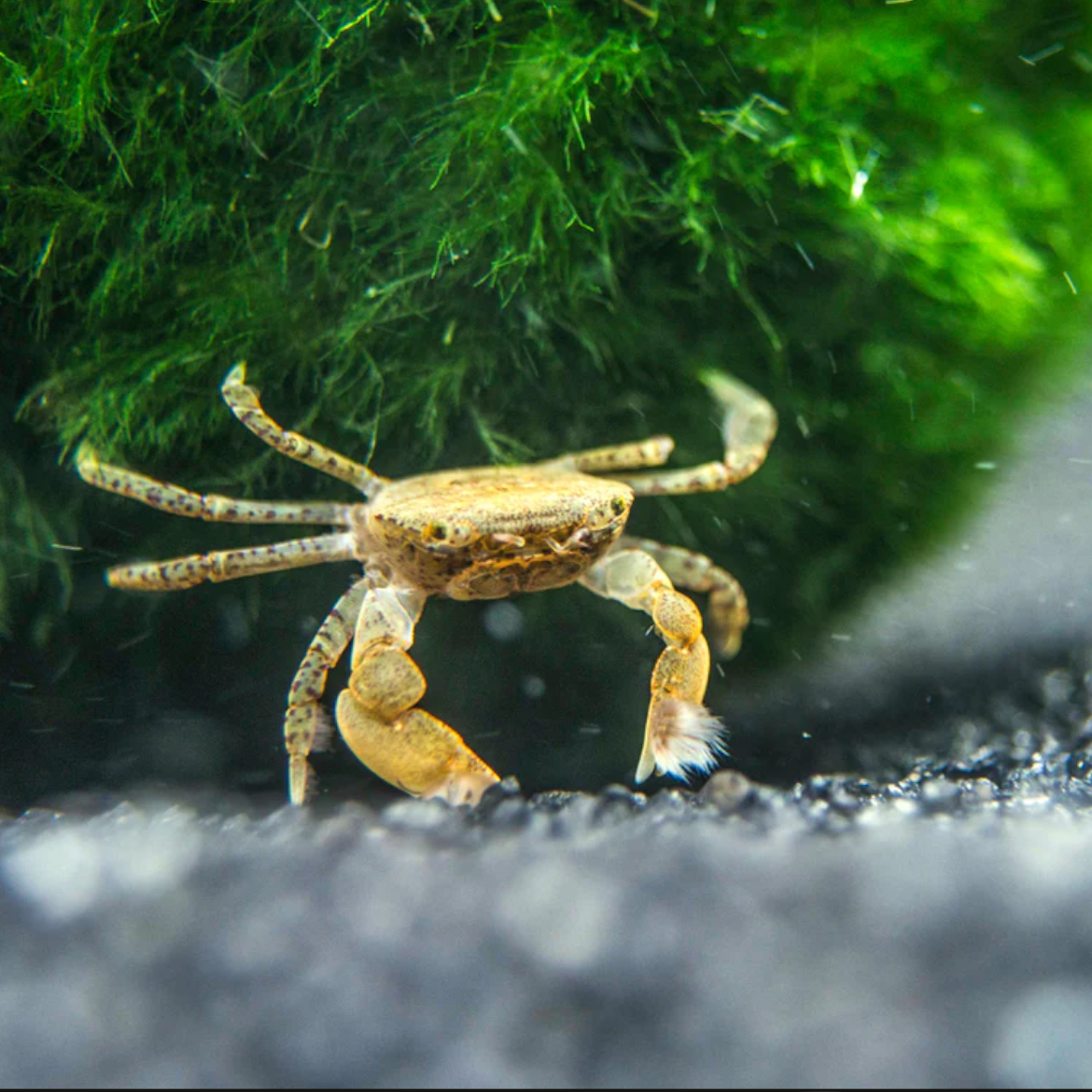
Freshwater Pom Pom Crab for Sale – Ptychognathus barbatus
Looking to buy Freshwater Pom Pom Crabs online? Pom Pom Crabs (Ptychognathus barbatus) are tiny, fully aquatic aquarium crabs known for the fuzzy bristles on their claws, active scavenging behavior, and unusual personality.
At only about 1/2 to 1 inch, these compact freshwater invertebrates fit naturally into mature planted aquariums and nano setups. Their distinctive “pom pom” claws are covered in fine setae that help them collect small food particles while they forage across rock, wood, substrate, and plants.
Adult SizeApproximately 1/2 to 1 inch.
Fully AquaticNo land section is required, but a secure lid is strongly recommended.
TemperamentGenerally peaceful, shy, and opportunistic.
Available Packs1, 5, or 10 crabs.
Which Pom Pom Crab pack should you choose?
-
1 crab: Best for adding an individual to a mature established aquarium.
-
5 crabs: A small group for a planted aquarium with abundant hiding places and floor space.
-
10 crabs: Best reserved for larger, mature aquariums with extensive structure, cover, and feeding surface.
Select your preferred quantity using the product options above this description.
Why Choose Freshwater Pom Pom Crabs?
-
Unique Fuzzy Claws that give the species its “pom pom” appearance.
-
Fully Aquatic Lifestyle with no terrestrial land section required.
-
Compact Adult Size suited to carefully planned nano and planted aquariums.
-
Active Foraging Behavior across substrate, hardscape, plants, and biofilm-rich surfaces.
-
Peaceful Personality compared with many larger freshwater crab species.
-
Freshwater Aquarium Appeal for hobbyists who want something different from shrimp, snails, or fish.
What Do Freshwater Pom Pom Crabs Look Like?
Pom Pom Crabs have a compact rounded body, long walking legs, and small claws covered in distinctive bristle-like setae. Their coloration can range through tan, brown, gray, and muted golden tones, helping them blend into natural hardscape.
The fuzzy claw structures are the feature that makes them instantly recognizable. Pom Pom Crabs frequently hold, wave, and pick with these claws while searching surfaces and the water column for edible material.
Pom Pom Crab Water Parameters
Stable, clean water is more important than chasing an exact number. Introduce Pom Pom Crabs only to a fully cycled aquarium and avoid sudden shifts in temperature, pH, hardness, or dissolved solids.
| Parameter |
Recommended Range |
| pH |
6.5–7.8 |
| GH |
4–10 dGH |
| KH |
2–6 dKH |
| TDS |
100–200 ppm |
| Temperature |
72–78°F |
| Ammonia |
0 ppm |
| Nitrite |
0 ppm |
| Minimum Tank Size |
5+ gallons; more space recommended for groups |
Use a mature biological filter and maintain consistent water quality. Like other freshwater invertebrates, Pom Pom Crabs can be sensitive to poor water conditions and sudden parameter changes.
Best Tank Setup for Pom Pom Crabs
Mature, Fully Cycled Aquarium
A mature aquarium provides biological stability plus established biofilm and microorganisms for natural grazing. Avoid adding these crabs to a newly set up or uncycled tank.
Secure Lid
Pom Pom Crabs are capable climbers. Use a tight-fitting lid and close gaps around cords, airline tubing, filter plumbing, and equipment openings.
Hiding Places & Molting Cover
Provide caves, driftwood, rockwork, leaf litter, dense plants, and shaded spaces where the crabs can retreat. Cover is especially important during and after molting when the new exoskeleton is still soft.
Plants & Hardscape
Live plants, moss, wood, and rock provide extra grazing surface and visual cover. Browse our live aquarium plants when preparing a mature planted setup.
What Do Pom Pom Crabs Eat?
Freshwater Pom Pom Crabs are opportunistic omnivores and scavengers. They graze on biofilm and fine organic material while also accepting prepared foods.
| Food Source |
Role in the Aquarium |
| Biofilm & microorganisms |
Natural grazing material on mature surfaces |
| Fine sinking foods |
Useful staple supplement that reaches the bottom |
| Algae-based foods |
Provides additional plant-based nutrition |
| Small meaty foods |
Useful occasional protein source |
| Leftover aquarium food |
May be scavenged, but should not be their only nutrition |
Do not rely on algae or leftover fish food alone. Feed enough that the crabs can obtain food consistently without allowing uneaten food to accumulate and damage water quality.
Browse our food and botanicals collection for supplemental feeding options.
Are Pom Pom Crabs Safe With Shrimp?
Pom Pom Crabs are generally peaceful, but they are still opportunistic crustaceans. Healthy adult shrimp may coexist successfully in a well-fed, heavily structured aquarium, while newborn shrimplets and freshly molted shrimp can be more vulnerable.
If protecting a valuable breeding colony is the priority, keeping the crabs separately is the lowest-risk option.
Pom Pom Crab Tank Mates
Choose small, peaceful tank mates that will not attack, harass, or outcompete the crabs. Calm nano fish, snails, and some adult shrimp may work in suitably structured aquariums.
Avoid large predatory fish, aggressive bottom dwellers, and other crustaceans likely to compete aggressively for territory or food.
Pom Pom Crab Molting
Like shrimp and other crustaceans, Pom Pom Crabs periodically shed their exoskeleton as they grow. A freshly molted crab is soft and vulnerable, so plenty of hiding places and stable mineralized water are important.
Do not automatically remove an empty shell if the crab is healthy—the shed exoskeleton can be mistaken for a dead crab.
Do Freshwater Pom Pom Crabs Need Land?
No terrestrial area is required. Freshwater Pom Pom Crabs are kept as fully aquatic crabs, making them very different from fiddler crabs, red claw crabs, and many other aquarium crabs that require access to land.
A secure lid is still essential because fully aquatic does not mean escape-proof.
Freshwater Pom Pom Crab vs. Marine Pom Pom Crab
| Trait |
Freshwater Pom Pom Crab |
Marine Pom Pom / Boxer Crab |
| Water type |
Freshwater aquarium trade species |
Saltwater / reef species |
| Scientific identification |
Ptychognathus barbatus in the aquarium trade |
Different marine crab species |
| “Pom poms” |
Bristle-like setae on the claws |
Known for carrying small sea anemones |
| Aquarium type |
Mature freshwater setup |
Marine reef aquarium |
Pom Pom Crab Price & Pack Options
Use the live product options above for current pricing. Available pack sizes include:
Acclimating Pom Pom Crabs After Delivery
Shipping water can differ from your aquarium in temperature, pH, GH, KH, and TDS. Gradual acclimation helps reduce stress while the crab adjusts to its new system.
Follow our Freshwater Shrimp Acclimation Guide as a gradual-acclimation reference before releasing your livestock.
Live Arrival & DOA Policy: Livestock orders are covered by our
Live Arrival Guarantee / DOA Policy. Review the policy before ordering for arrival, documentation, and claim requirements.
Invertebrate Safety: Avoid copper-based medications and other treatments that are unsafe for aquatic invertebrates. Always confirm medication compatibility before treating an aquarium containing crabs, shrimp, or snails.
Ready to add Freshwater Pom Pom Crabs to your aquarium?
Select your preferred 1, 5, or 10-crab pack above and add one of the aquarium hobby’s most unusual fully aquatic invertebrates to your tank.
Pom Pom Crab Care Guides
Learn more about setup, water quality, feeding, acclimation, and compatibility before adding Pom Pom Crabs to your aquarium.
Freshwater Pom Pom Crab FAQ
Are Freshwater Pom Pom Crabs fully aquatic?
Yes. They are kept fully submerged and do not require a terrestrial land section. A secure aquarium lid is still strongly recommended because they can climb.
How big do Pom Pom Crabs get?
Our listed Pom Pom Crabs are approximately 1/2 to 1 inch at adult size.
Why are they called Pom Pom Crabs?
The name comes from the dense bristle-like setae on the claws, which can resemble tiny pom poms as the crab waves and picks at food.
What water parameters do Pom Pom Crabs need?
Our listed range is pH 6.5–7.8, GH 4–10 dGH, KH 2–6 dKH, TDS 100–200 ppm, and 72–78°F, with zero measurable ammonia and nitrite.
What size aquarium do Pom Pom Crabs need?
We list 5 gallons or larger as the minimum. Larger groups benefit from more floor space, hardscape, hiding places, and feeding surface.
Do Pom Pom Crabs need a lid?
Yes. They are capable climbers and can escape through surprisingly small openings around equipment, tubing, and filter gaps.
What do Freshwater Pom Pom Crabs eat?
They are opportunistic omnivores and scavengers that graze biofilm and fine organic material while accepting sinking foods, algae-based foods, and small protein-rich foods.
Are Pom Pom Crabs safe with shrimp?
They are generally peaceful, and healthy adult shrimp may coexist with them, but shrimplets and freshly molted shrimp can be vulnerable. Separate housing is safest for valuable breeding colonies.
Can Pom Pom Crabs live with fish?
They can coexist with appropriately small, peaceful fish that will not attack or harass them. Avoid aggressive or predatory species.
Do Pom Pom Crabs eat algae?
They may graze soft algae and biofilm, but they should not be purchased as a complete algae-control solution.
Do Pom Pom Crabs need a filter?
Yes. A mature biological filter and clean, oxygenated water are strongly recommended. Gentle to moderate flow also helps keep the aquarium healthy.
What happens when a Pom Pom Crab molts?
The crab sheds its old exoskeleton and remains soft and vulnerable while the new shell hardens. Provide secure hiding places and avoid disturbing a freshly molted crab.
Can Pom Pom Crabs breed in a freshwater aquarium?
Successful captive breeding is uncommon and their larval requirements are considerably more complex than freshwater-breeding shrimp such as Neocaridina. Do not expect a self-sustaining colony in a typical freshwater aquarium.
Buy Freshwater Pom Pom Crabs Online
Freshwater Pom Pom Crabs combine unusual fuzzy claws, compact size, active scavenging behavior, and a fully aquatic lifestyle in one distinctive freshwater invertebrate.
Choose your Pom Pom Crab pack above and add a unique bottom-dwelling invertebrate to your mature aquarium.