

Blue Dream Shrimp and Blue Velvet Shrimp are two of the most popular blue Neocaridina in the freshwater aquarium hobby, and they are also two of the easiest varieties to confuse.
Both are blue Neocaridina. Both stay small. Both have essentially the same care requirements. Both can breed entirely in freshwater. And both can range somewhat in color from one individual to another.
The main difference is appearance: Blue Dream Shrimp are generally selected for a darker, deeper navy-blue body, while Blue Velvet Shrimp are generally selected for a lighter, brighter, more translucent blue appearance.
If you already know you prefer the darker look, browse our Blue Dream shrimp for sale. If you prefer a lighter sky-blue or translucent blue colony, see our Blue Velvet shrimp for sale.
Blue Dream vs. Blue Velvet Shrimp: Quick Comparison
| Feature | Blue Dream Shrimp | Blue Velvet Shrimp |
|---|---|---|
| Typical Color | Deep blue to navy blue | Lighter blue to sky blue, often more translucent |
| Species Group | Neocaridina | Neocaridina |
| Adult Size Sold | About 1/2–1 inch, breeding age | About 1/2–1 inch, breeding age |
| Care Difficulty | Beginner-friendly | Beginner-friendly |
| Water Parameters | Same current Shrimp Up system range | Same current Shrimp Up system range |
| Freshwater Breeding | Yes | Yes |
| Can They Interbreed? | Yes. Keep the lines separate if you want to preserve a consistent appearance. | |
| Best For | Dark, saturated blue display | Bright, lighter blue display |
What Are Blue Dream Shrimp?
Blue Dream Shrimp are a selectively bred blue Neocaridina color line known for deeper pigmentation.
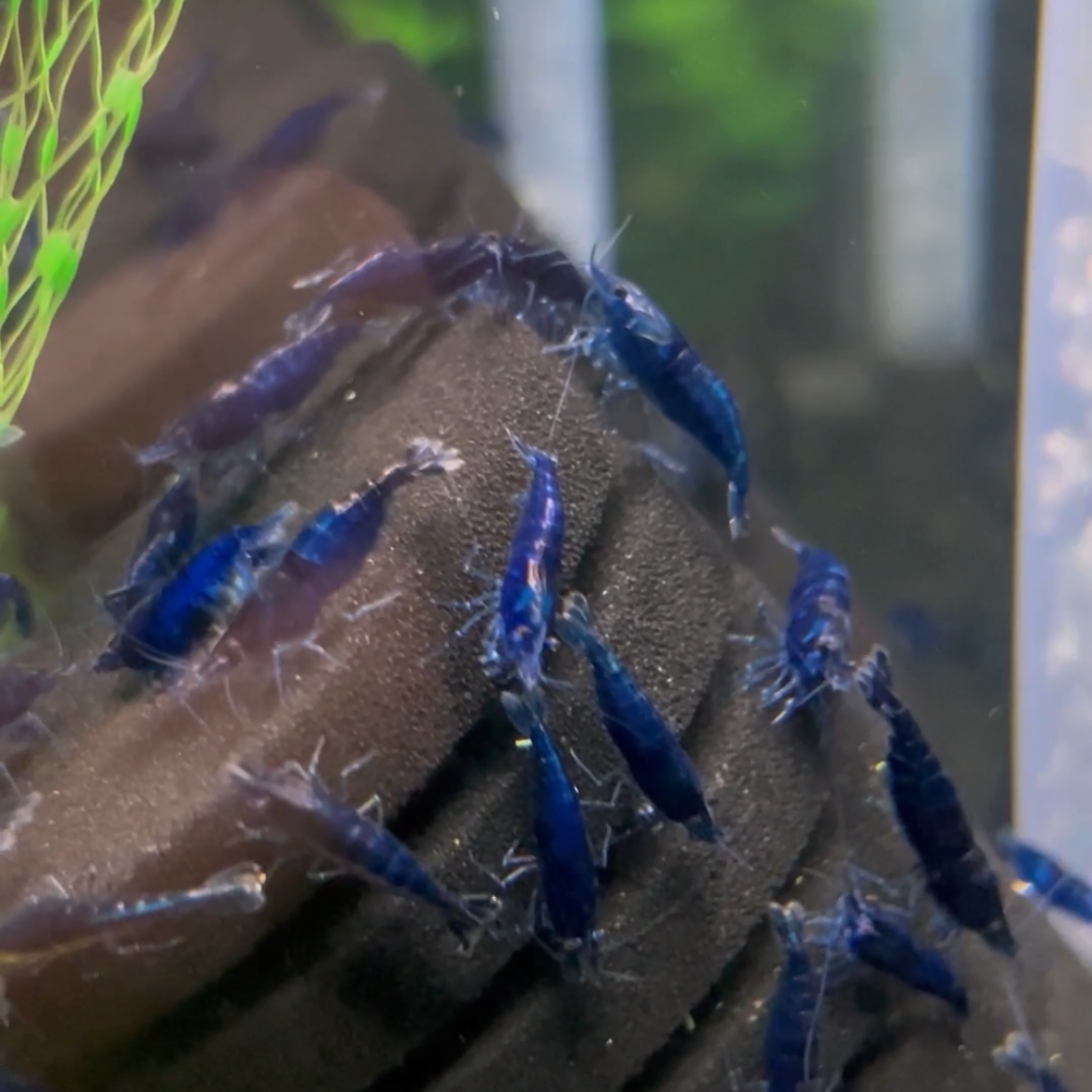
In the current Shrimp Up Aquatics Blue Dream line, many individuals show rich royal-blue to navy-blue coloration. Some can be so dark that they appear nearly black under low light, while others are visibly brighter blue.
The overall look is usually more saturated and opaque than Blue Velvet.
That makes Blue Dream especially striking against:
- Bright green moss
- Light-colored rock
- Natural brown driftwood
- Open foreground areas
- Medium-to-light substrates that create visual contrast
What Are Blue Velvet Shrimp?
Blue Velvet Shrimp are another blue Neocaridina line, but the desired appearance is usually lighter and more translucent.
The current Shrimp Up Aquatics Blue Velvet listing specifically describes the line as having light blue coloration. Individual shrimp can still vary, with some appearing brighter and others somewhat darker, but the overall visual target is different from the deep navy appearance associated with Blue Dream.
Blue Velvet Shrimp can look especially attractive against:
- Dark substrate
- Black sponge filters
- Dark driftwood
- Deep green plants
- Black aquarium backgrounds
A lighter blue shrimp often remains easier to see against a dark aquascape where an extremely dark Blue Dream may partially disappear.

The Biggest Difference Is Shade and Opacity
If you place a representative Blue Dream beside a representative Blue Velvet, the easiest distinction is usually color depth.
Blue Dream: darker, more saturated, often more opaque.
Blue Velvet: lighter, brighter, often more translucent.
But shrimp coloration is not perfectly uniform.
A lighter Blue Dream can overlap visually with a darker Blue Velvet. Sex, age, lighting, substrate, individual genetics, and environmental conditions can all affect how a shrimp looks at a particular moment.
That is why you should think of these names as selectively maintained aquarium color lines, not two different biological species with a hard scientific boundary between every possible shade.
There Is No Universal Color Chart Every Breeder Uses
This is one reason hobbyists sometimes disagree about whether a particular shrimp is a Blue Dream, Blue Velvet, Blue Jelly, or another blue line.
Commercial line names describe the appearance and breeding line being maintained by a seller or breeder. Different breeders may use slightly different naming or grading conventions.
For Shrimp Up Aquatics specifically, the practical distinction is straightforward:
- Blue Dream = deeper, darker blue.
- Blue Velvet = lighter blue.
When purchasing, compare the actual livestock photos from the seller rather than relying only on a generic internet color chart.
Are Blue Dream and Blue Velvet the Same Species?
Yes. They are both ornamental Neocaridina color varieties and share the same basic biological care requirements.
Scientific literature on Neocaridina davidi documents how generations of selective breeding have produced visibly different ornamental color forms. That is important because color differences do not automatically mean a different species or a different style of basic husbandry.
In other words, choosing between Blue Dream and Blue Velvet is primarily a decision about the look of the colony—not about one requiring completely different water from the other.
Do Blue Dream and Blue Velvet Need Different Water Parameters?
No. The current Shrimp Up Aquatics product pages list the same system parameters for both varieties:
| Parameter | Blue Dream | Blue Velvet |
|---|---|---|
| pH | 7.0–7.8 | 7.0–7.8 |
| GH | 7–8 dGH | 7–8 dGH |
| KH | 3–4 dKH | 3–4 dKH |
| TDS | 200–250 ppm | 200–250 ppm |
| Temperature | 65–74°F | 65–74°F |
Those are the conditions used in our systems, not numbers that every keeper must chase exactly.
Stable, appropriate Neocaridina water is more important than trying to force the aquarium to match one precise number.
For a complete step-by-step breakdown on tank setup and maintaining stable parameters, refer to our comprehensive Blue Dream Shrimp Care Guide as well as our general Neocaridina Shrimp Water Parameters Guide.
Does Substrate Affect How Blue Shrimp Look?
Yes—both visually and, to some extent, physiologically.
Background color can influence the way ornamental shrimp coloration appears. A peer-reviewed study published in the Journal of the World Aquaculture Society found that female Neocaridina davidi raised on black backgrounds showed greater colored carapace area and higher astaxanthin content than shrimp raised on lighter backgrounds.
The study used red shrimp rather than Blue Dream or Blue Velvet specifically, so it should not be treated as proof that a black substrate will genetically turn blue shrimp darker.
But it does reinforce something aquarists routinely notice: environment and background can influence how strongly ornamental shrimp coloration is expressed and perceived.
For a Blue Dream tank, a dark substrate can make the overall setup look dramatic, but very dark individuals may be harder to see.
For Blue Velvet, a dark substrate usually creates strong contrast with the lighter blue body.
Does Diet Affect Blue Dream or Blue Velvet Color?
Genetics determine the basic color line, but diet and overall condition can affect the appearance of ornamental shrimp.
A separate study in Aquaculture Nutrition evaluated commercial diets in Neocaridina davidi and found brighter body coloration and greater carotenoid content in shrimp receiving a diet with higher carotenoid content.
Again, the experiment was performed on red cherry shrimp rather than specifically on Blue Dream and Blue Velvet, so the lesson is not “feed carotenoids to make shrimp blue.”
The useful takeaway is that body coloration is influenced by more than the strain name alone. Genetics, nutrition, sex, maturity, background, and health all contribute to what you see.
Which Is Darker: Blue Dream or Blue Velvet?
Blue Dream is generally the darker of the two.
Our current Blue Dream photos show individuals ranging from bright royal blue to deep navy.
Blue Velvet generally has more visible translucence and a lighter blue appearance.

Which Is Brighter: Blue Dream or Blue Velvet?
If by “brighter” you mean a lighter, more sky-blue shrimp that catches the eye against dark substrate, Blue Velvet is usually the better choice.
Its body can allow more light through the exoskeleton, giving the shrimp a brighter appearance even though it has less overall pigment density.

Which Blue Shrimp Looks Better in a Planted Tank?
There is no universal winner. The better shrimp depends on the aquascape.
Choose Blue Dream if:
- You want the deepest possible blue look.
- Your tank uses lighter hardscape or bright green plants.
- You prefer a more saturated, opaque shrimp.
- You want a dramatic single-color colony.
Choose Blue Velvet if:
- You prefer lighter, cleaner blue tones.
- Your aquarium has dark substrate or dark wood.
- You want the shrimp to stay highly visible against a black background.
- You like a somewhat more translucent appearance.
Our Neocaridina Shrimp Aquascaping Guide goes deeper into matching shrimp coloration with plants, substrate, hardscape, and viewing areas.
Do Blue Dream and Blue Velvet Grow to Different Sizes?
No meaningful care distinction exists here.
Both current Shrimp Up Aquatics listings sell the shrimp at approximately 1/2 to 1 inch and breeding age.
Adult size varies somewhat by sex, age, nutrition, and individual growth. Mature females are generally larger and broader than males.
If you are trying to identify males and females before breeding, our Male vs. Female Neocaridina Shrimp Guide explains body shape, saddles, egg carrying, and other differences.
Are Blue Dream or Blue Velvet Easier to Keep?
Neither has a meaningful advantage in basic care.
They are both beginner-friendly Neocaridina and currently come from the same Shrimp Up Aquatics water parameter range.
Both need:
- A fully cycled aquarium
- Stable water chemistry
- Zero ammonia
- Zero nitrite
- Appropriate GH and KH
- Shrimp-safe filtration
- Biofilm and grazing surfaces
- Responsible feeding
If you plan to keep either variety in a community setup with tank mates, read our guide on whether Blue Dream shrimp can live with fish to ensure maximum shrimplet survival.
Choose between them based on color, not because one is supposed to be dramatically hardier than the other.
Do Blue Dream and Blue Velvet Eat Different Foods?
No.
Both are omnivorous Neocaridina grazers and can be maintained on the same basic feeding program.
They naturally pick at biofilm, microorganisms, soft algae, and organic material growing throughout a mature aquarium.
Supplemental food can include quality shrimp pellets, algae-based foods, botanicals, and occasional appropriate protein.
The biggest feeding risk is overfeeding, not choosing a Blue Dream-specific or Blue Velvet-specific diet.
Can Blue Dream and Blue Velvet Shrimp Breed Together?
Yes.
Because both are Neocaridina color lines, they can interbreed.
This is important if you are trying to preserve the distinct appearance of either colony.
Mixing two blue lines does not guarantee that every offspring will simply become an “even better blue.” Genetics do not work that neatly. Offspring can vary in shade, opacity, pattern, and overall quality, and later generations can become increasingly unpredictable.
If your goal is to maintain a deep Blue Dream line, keep Blue Dreams separate.
If your goal is to maintain a lighter Blue Velvet line, keep Blue Velvets separate.
If you simply enjoy blue shrimp and do not care about maintaining a named line, keeping them together is not inherently harmful.
Our Complete Neocaridina Shrimp Breeding Guide explains selective breeding, berried females, shrimplets, colony growth, and why mixed color lines can produce unpredictable offspring.
Do Blue Dream and Blue Velvet Have the Same Breeder Pack?
Yes. Both current Shrimp Up Aquatics listings offer:
- 1 Shrimp
- 5 Shrimp
- 10 Shrimp
- 20 Shrimp
- Breeder Pack
The breeder pack is currently structured as 7 females and 3 males, for 10 shrimp total.
If you want to start a darker colony, you can buy Blue Dream shrimp in a breeder pack or regular group.
If you prefer the lighter line, you can buy Blue Velvet shrimp in the same pack-size structure.
Which Is Better for a Nano Aquarium?
Both.
A fully cycled 5-gallon aquarium can support a Neocaridina colony, while a 10-gallon tank is often easier for beginners because the larger water volume is more stable.
The real decision is visual:
- Dark tank + light blue shrimp: Blue Velvet can stand out strongly.
- Bright green planted tank + deep blue focal color: Blue Dream can look spectacular.
Which Is Better for Beginners?
Again, neither has a major care advantage.
If you are a new shrimp keeper, choose the color you actually want to look at for the next several generations.
A healthy colony may eventually contain dozens or even hundreds of descendants. The original color choice becomes a major part of the tank's identity.
Which Is Better for Breeding?
Both reproduce using the same basic Neocaridina reproductive cycle.
A mature female carries fertilized eggs beneath her abdomen until miniature shrimplets hatch directly into freshwater.
Breeding success depends far more on:
- Stable parameters
- Adult sex ratio
- Mature biofilm
- Moss and cover
- Shrimp-safe filtration
- Low predation
- Appropriate feeding
than whether the colony is labeled Blue Dream or Blue Velvet.
Which One Should You Buy?
The easiest decision rule is:
Choose Blue Dream Shrimp if you want deep navy or highly saturated blue.
Choose Blue Velvet Shrimp if you want a lighter, brighter, more translucent blue.
Both can be beautiful. Both are beginner-friendly. Both breed readily in the correct environment. Both use the same current Shrimp Up water parameters and pack structure.
If you are still uncertain, look at the actual product photos side by side rather than getting too caught up in hobby naming debates.
Frequently Asked Questions
Are Blue Dream and Blue Velvet Shrimp the same?
They are different selectively maintained color lines of blue Neocaridina, but they share the same basic species-level husbandry. The main practical difference is the desired shade and opacity of blue.
Is Blue Dream darker than Blue Velvet?
Generally, yes. Blue Dream is typically selected for deeper navy or saturated blue, while Blue Velvet is typically lighter and more translucent.
Can Blue Dream and Blue Velvet breed together?
Yes. They can interbreed. Keep the lines separate if preserving the appearance of either strain is important.
Will crossing Blue Dream and Blue Velvet make better blue shrimp?
Not necessarily. Offspring can vary unpredictably in shade, opacity, and pattern. Crossing two blue lines does not guarantee improved blue coloration.
Do Blue Dream and Blue Velvet need different water?
No. The current Shrimp Up Aquatics listings show the same tank water parameters for both varieties.
Which is better for beginners?
Both are beginner-friendly when the aquarium is fully cycled and stable. Pick the color you prefer.
Which one looks better on black substrate?
Blue Velvet often creates stronger visibility because its lighter blue body contrasts with black substrate. Dark Blue Dreams can still look dramatic, but the darkest individuals may blend into a very dark aquascape.
Which one looks better with bright green plants?
Both work well. Deep Blue Dream pigmentation can create especially strong contrast against bright green foliage.
Blue Dream vs. Blue Velvet: Final Verdict
Blue Dream and Blue Velvet Shrimp are much more alike than they are different.
They are both blue Neocaridina. They use the same basic care. They grow to similar sizes. They eat the same foods. They breed using the same reproductive process. They can even reproduce with one another.
The real difference is what you want the colony to look like.
If your ideal shrimp is dark, saturated, and navy blue, choose Blue Dream Neocaridina shrimp for sale.
If your ideal shrimp is brighter, lighter, and more translucent blue, choose Blue Velvet Neocaridina Shrimp for sale.
If you want to compare even more colors before building your colony, browse our complete Neocaridina shrimp collection.
Whichever blue line you choose, keep the aquarium stable, allow it to mature, provide plenty of biofilm and plants, and keep the color line separate if long-term consistency matters to you.
Sources & References
Journal of the World Aquaculture Society — Effect of background color and shelters on female pigmentation in Neocaridina davidi — Peer-reviewed research examining how background substrate color influenced pigmentation and astaxanthin content in ornamental Neocaridina.
Aquaculture Nutrition — Effect of diets on carotenoid content and body coloration in Neocaridina davidi — Peer-reviewed research examining diet, carotenoid content, body coloration, survival, and reproductive quality in ornamental Neocaridina.