

Yes, Blue Dream Shrimp can live with some fish—but “compatible” does not mean completely safe.
Blue Dream Shrimp are peaceful Neocaridina davidi, so they will not attack fish. The risk goes in the opposite direction: many fish will opportunistically eat shrimp, and even tiny community fish that ignore healthy adults may hunt newborn shrimplets.
That means the right setup depends on your goal. If you want a colorful community aquarium where most adult shrimp remain visible, carefully selected small fish can work. If your goal is to build the largest possible Blue Dream breeding colony, a shrimp-only tank is the better choice.
If your aquarium is cycled and you are ready to stock it, browse Blue Dream shrimp for sale at Shrimp Up Aquatics. Our current Blue Dream listing includes 1-, 5-, 10-, and 20-shrimp options plus a breeder pack for hobbyists starting a colony.
Can Blue Dream Shrimp Live With Fish?
They can, but there is no useful blanket answer for every fish species.
When evaluating a fish as a Blue Dream tank mate, ask four questions:
- Can the fish physically fit an adult shrimp in its mouth?
- Will it actively hunt small moving prey?
- Will it harass shrimp even if it cannot swallow them?
- Are you trying to preserve baby shrimp?
The final question changes everything.
A fish can coexist peacefully with adult Blue Dream Shrimp and still dramatically reduce colony growth by eating shrimplets. Newborn Neocaridina are tiny, soft-bodied, and much easier prey than a mature adult.
A field study on Neocaridina davidi published in Limnologica found that only a small percentage of eggs ultimately reached adulthood in the wild population studied, with intensive predation by native and introduced fish identified as a likely major factor. An aquarium is obviously different from a river, but the biological lesson is directly relevant: tiny shrimp are prey-sized animals.
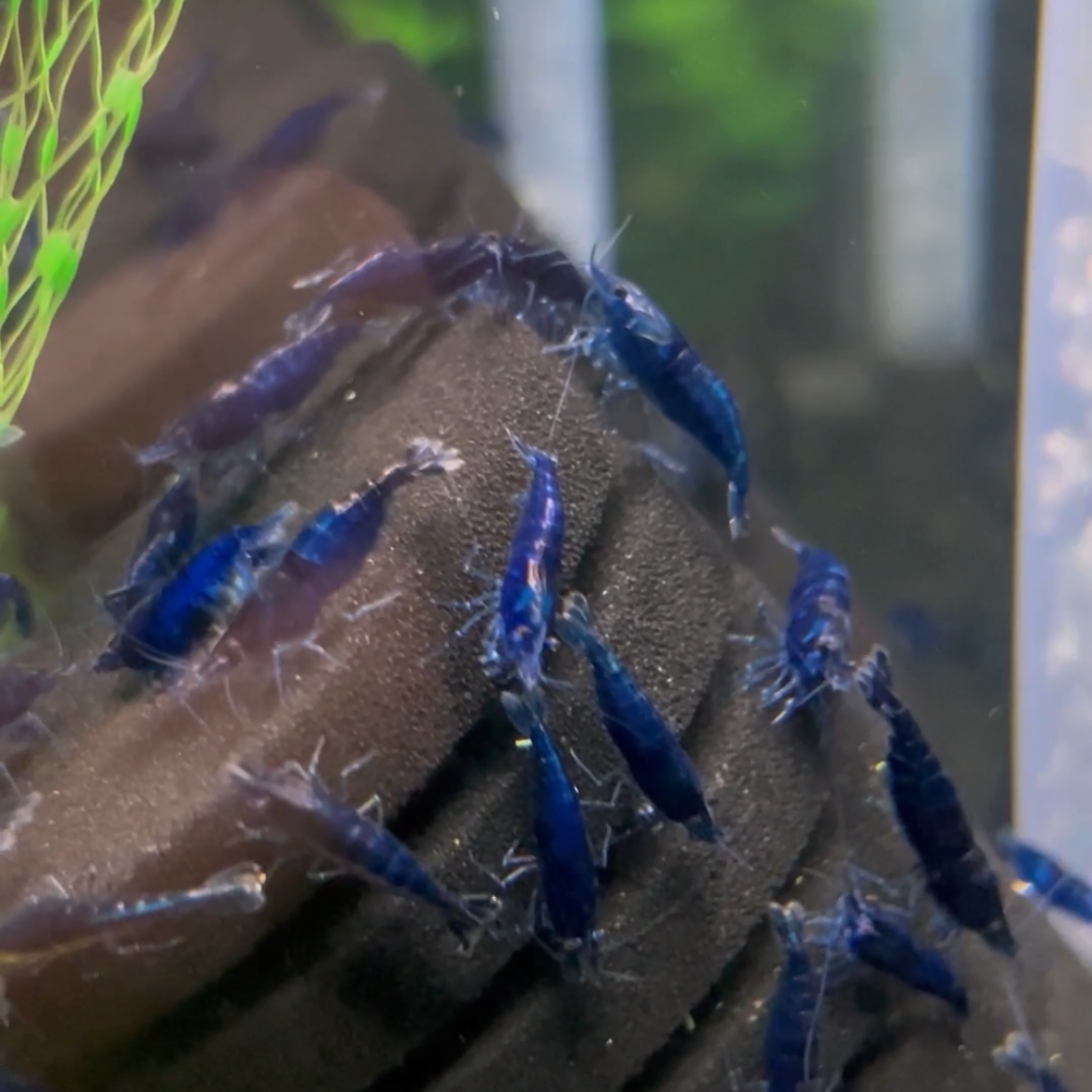
The Safest Blue Dream Tank Mate Is Another Shrimp
If breeding success is your top priority, the safest setup is a dedicated Blue Dream aquarium.
A shrimp-only tank removes the biggest predation variable and lets you design every part of the aquarium around:
- Biofilm production
- Shrimplet survival
- Gentle filtration
- Stable water chemistry
- Dense moss and plants
- Selective breeding
This does not mean community tanks are a bad idea. It means the expected outcome should match the setup.
Shrimp-only tank: best for colony growth.
Shrimp + very small peaceful fish: adults may do well, but expect some baby losses.
Shrimp + larger or predatory fish: adult losses become much more likely.
Best Tank Mates for Blue Dream Shrimp
No fish should be marketed as perfectly shrimp-safe, especially where shrimplets are concerned. However, some tank mates generally create much less risk than others.
1. Freshwater Snails — Safest Overall
If you want another animal in the tank without introducing fish predation, freshwater snails are one of the safest choices.
Nerite, ramshorn, Malaysian trumpet, and similar peaceful aquarium snails do not hunt healthy Blue Dream Shrimp.
They also occupy many of the same mature planted-tank environments without creating the constant predator-prey pressure that fish can.
2. Otocinclus Catfish — Lower-Risk Fish Choice
Otocinclus are small, peaceful algae-grazing catfish and are among the lower-risk fish choices for adult dwarf shrimp.
They are not active shrimp hunters, and their feeding behavior is centered much more heavily on algae and surface grazing than chasing crustaceans.
However, calling any fish “100% shrimplet-safe” is too strong. A dedicated breeding tank without fish remains the safest option.
3. Pygmy Corydoras — Generally Lower Risk
Pygmy Corys are tiny, peaceful catfish that can work in some planted Blue Dream community aquariums.
Their small adult size makes them much less threatening than large Corydoras or predatory bottom fish.
Still, a newborn shrimplet is extremely small. Do not assume every baby will survive simply because the fish is peaceful.
4. Chili Rasboras and Other Tiny Rasboras — Conditional
Very small rasboras can coexist with adult Blue Dream Shrimp in heavily planted aquariums.
They occupy open and midwater areas while the shrimp spend most of their time on surfaces.
The problem is shrimplets. Tiny fish are still capable of eating very tiny shrimp.
If you choose rasboras, use dense moss, fine-leaved plants, wood, leaf litter, and other structure that creates places fish cannot easily search.
5. Celestial Pearl Danios / Galaxy Rasboras — Conditional
Celestial Pearl Danios are small and relatively peaceful, making them a common candidate for shrimp community tanks.
Healthy adults may coexist, but small shrimp can still become food.
Think of this pairing as a display setup rather than the ideal breeding setup.
6. Small Peaceful Tetras — Higher Shrimplet Risk
Very small tetras such as Ember Tetras may coexist with adult shrimp in a densely planted tank, but their feeding behavior makes shrimplet predation a realistic possibility.
If colony growth matters more than fish variety, skip the tetras.
Blue Dream Tank-Mate Risk Chart
| Tank Mate | Adult Shrimp Risk | Shrimplet Risk | Best Use |
|---|---|---|---|
| Peaceful snails | Very low | Very low | Breeding or display |
| Otocinclus | Low | Low but not zero | Planted display |
| Pygmy Corydoras | Low | Possible | Community display |
| Tiny rasboras | Low to moderate | Moderate | Heavily planted display |
| Small tetras | Low to moderate | Moderate to high | Display, not maximum breeding |
| Betta / gourami | Variable to high | High | Not recommended for valuable colony |
| Cichlids / large fish | High | Very high | Avoid |
Fish to Avoid With Blue Dream Shrimp
Some fish are simply poor choices when the shrimp matter to you.
Bettas
Betta behavior varies dramatically between individuals. Some ignore adult shrimp for long periods. Others immediately hunt them.
That unpredictability makes a valuable Blue Dream colony a poor experiment.
Gouramis
Many gouramis are curious, predatory omnivores with mouths large enough to injure or consume shrimp.
Cichlids
Most cichlids are inappropriate tank mates for dwarf shrimp. Even relatively small dwarf cichlids are capable predators.
Goldfish
Goldfish are large opportunistic feeders and are not appropriate Blue Dream tank mates.
Loaches
Many loaches actively search the substrate and crevices for small invertebrates. They are poor choices for a shrimp colony.
Large Tetras, Barbs, and Similar Fish
Once a fish becomes large enough to swallow an adult Blue Dream, the pairing stops being a reasonable risk.
Adult Blue Dreams and Baby Blue Dreams Are Two Different Compatibility Problems
This is the most important concept in the entire tank-mate discussion.
An adult Blue Dream Shrimp is roughly 1/2 to 1 inch on the current Shrimp Up Aquatics listing. A newborn shrimplet is tiny.
A fish that physically cannot swallow an adult may have no problem eating a newly hatched shrimp.
So when someone says, “My fish has never bothered my shrimp,” the next question should be:
Are baby shrimp surviving to adulthood?
A peaceful display can look successful while reproduction is being quietly suppressed by predation.
If you are building a breeding colony, our complete Neocaridina breeding guide explains how to maximize survival from berried females through juvenile growth.

Dense Cover Makes Fish and Shrimp More Compatible
If you are committed to keeping fish with Blue Dream Shrimp, habitat design matters enormously.
A study on different color morphs of Neocaridina davidi published in Animals discusses habitat and background use in relation to camouflage and protection from predators. In a community aquarium, physical cover gives shrimp something even more useful than visual camouflage: areas fish cannot easily enter or search.
Build the tank with multiple layers of shelter.
Java Moss and Dense Mosses
Moss is one of the best structures for shrimp-and-fish tanks because adults and shrimplets can move deep into fine branches that many fish cannot effectively penetrate.
Dense Stem Plants
Closely spaced stems create visual barriers and break up direct hunting paths.
Driftwood
Branching wood creates undersides, cracks, shaded areas, and biofilm-covered surfaces.
Rock Crevices
Small gaps between shrimp-safe rocks give shrimp protected resting and molting areas.
Leaf Litter and Botanicals
Botanicals add physical complexity at substrate level while developing biofilm.
Our Neocaridina Shrimp Tank Aquascaping Guide covers plant placement, substrate, hardscape, grazing surfaces, and shrimp-safe layout design in greater depth.
Best Tank Size for Blue Dream Shrimp With Fish
A Blue Dream-only colony can work in a properly maintained 5-gallon tank, but once fish are added, more space becomes valuable.
For a true shrimp-and-fish community, a 10-gallon or larger aquarium usually makes more sense, with the exact minimum determined by the fish species.
Larger water volume provides:
- More stable temperature
- More stable water chemistry
- More grazing surfaces
- More hiding areas
- More separation between shrimp and fish
- More room to meet the fish species' own swimming requirements
Do not choose tank size based only on the shrimp. The fish usually determine the true minimum.
Use Shrimp-Safe Filtration
A community tank still needs filtration that protects shrimplets.
Sponge filters are excellent because they:
- Provide biological filtration
- Create gentle flow
- Offer a huge grazing surface
- Do not pull baby shrimp into a conventional intake
If you use a hang-on-back or canister filter, cover the intake with an appropriate pre-filter sponge.
Blue Dream Water Parameters Still Come First
Tank mates should be selected from fish that tolerate the same stable water conditions as your shrimp—not the other way around. If you are setting up a tank from scratch, our detailed Blue Dream Shrimp Care Guide covers full aquarium setup, dietary requirements, and long-term colony maintenance.
The current Shrimp Up Aquatics Blue Dream systems are maintained around:
| Parameter | Our Blue Dream Systems |
|---|---|
| pH | 7.0–7.8 |
| GH | 7–8 dGH |
| KH | 3–4 dKH |
| TDS | 200–250 ppm |
| Temperature | 65–74°F |
| Ammonia | 0 ppm |
| Nitrite | 0 ppm |
These are the conditions used in our Blue Dream systems, not universal numbers that every aquarium must exactly match.
For the chemistry behind GH, KH, pH, and TDS, read our Neocaridina Shrimp Water Parameters Guide.
Do Not Add Fish and Shrimp to an Uncycled Tank
Adding more species does not make a young aquarium more stable.
Before stocking Blue Dreams or their tank mates:
- Ammonia should be 0 ppm.
- Nitrite should be 0 ppm.
- The biological filter should already be established.
- Temperature should be stable.
- GH, KH, and pH should be appropriate.
- The aquarium should ideally contain mature biofilm and plants.
Shrimp benefit enormously from biological maturity because they spend much of their time grazing on microorganisms and organic material growing across aquarium surfaces.
Feed Fish Without Starving or Overfeeding the Shrimp
Community feeding becomes more complicated because fish and shrimp do not always eat at the same speed.
If you feed only floating or fast-sinking fish food, the shrimp may receive very little.
If you add excessive shrimp food to compensate, uneaten food can accumulate and damage water quality.
A better approach is controlled feeding:
- Feed the fish appropriately.
- Provide dedicated shrimp food in small amounts.
- Place shrimp food near cover where shrimp can reach it.
- Remove or reduce food when large amounts remain uneaten.
- Let mature biofilm contribute to the shrimp diet.
Should You Introduce the Shrimp or Fish First?
If possible, establish the Blue Dream colony before adding fish.
This allows the shrimp to:
- Learn the tank structure
- Establish preferred hiding areas
- Begin grazing naturally
- Potentially reproduce before fish predation begins
A mature shrimp population also gives the aquarium more resilience than adding a handful of new shrimp directly into a tank already occupied by curious fish.
When adding new shrimp, use a controlled acclimation process. Our Freshwater Shrimp Acclimation Guide covers the process step by step.

How Many Blue Dream Shrimp Should You Start With in a Fish Tank?
A group of around 10 Blue Dreams is a practical starting point for many mature community aquariums, provided the tank has enough cover and the fish are appropriate.
Starting with more than just a couple shrimp gives the group a better chance of remaining visible even when some individuals spend time hiding.
If your primary goal is breeding rather than display, the current Blue Dream breeder pack contains 7 females and 3 males for a total of 10 shrimp.
When the tank is ready, you can buy Blue Dream shrimp in the pack size that matches your aquarium and colony goals.
How to Tell Whether Your Fish Are Stressing the Shrimp
Predation is not the only compatibility problem.
A fish may repeatedly chase, nip at, or investigate shrimp without actually eating them.
Watch for:
- Shrimp hiding almost constantly
- Very little open grazing
- Fish repeatedly chasing shrimp
- Missing antennae or limbs
- Adult shrimp disappearing
- Berried females disappearing
- No visible juvenile recruitment over time
If the shrimp never behave normally while the fish are present, the pairing is not working simply because both species are still alive.
Can Blue Dream Shrimp Live With Bettas?
Sometimes an individual betta ignores shrimp. Sometimes it does not.
That makes the combination unpredictable.
If the Blue Dreams are inexpensive test livestock and you accept losses, some hobbyists experiment with heavily planted betta tanks. If you are buying a valuable breeding colony, the risk is difficult to justify.
For a serious Blue Dream setup, we would not choose a betta as the first tank mate.
Can Blue Dream Shrimp Live With Guppies or Endlers?
Adults may coexist with small livebearers in planted aquariums, but the fish are opportunistic feeders and can eat shrimplets.
The combination is much better suited to a colorful display tank than a high-survival breeding tank.
Can Blue Dream Shrimp Live With Corydoras?
Small peaceful Corydoras—especially Pygmy Corys—are among the more reasonable catfish choices.
Larger Corydoras are still generally peaceful, but more body size means a larger mouth and more disturbance across the bottom of the tank.
For maximum shrimplet survival, shrimp-only still wins.
Can Blue Dream Shrimp Live With Rasboras?
Tiny rasboras are some of the more common fish used in shrimp community tanks.
Adults can coexist well when the tank is densely planted, but newborn shrimp remain prey-sized.
Use moss and dense fine-leaved plants if you want any meaningful juvenile survival.
Can Blue Dream Shrimp Live With Tetras?
Some very small peaceful tetra species can coexist with adults.
As tetra size increases, so does predation risk.
If you want both species, choose the smallest appropriate peaceful tetra and design the tank around heavy cover.
Can Blue Dream Shrimp Live With Other Shrimp?
Yes, but there is an important genetic issue.
Blue Dream Shrimp can live with other Neocaridina color morphs, but those color lines can interbreed.
If you want to preserve deep blue offspring, keep your Blue Dreams separate from Fire Red, Yellow, Orange, Green Jade, Rili, and other Neocaridina colors.
Mixing colors is perfectly fine for a display colony when predictable offspring are not important.
Best Setup for a Blue Dream Shrimp and Fish Community Tank
A strong setup might include:
| Component | Recommended Approach |
|---|---|
| Tank | 10 gallons or larger, depending on fish species |
| Filter | Sponge filter or protected intake |
| Plants | Dense moss plus fine-leaved and broad-leaved plants |
| Hardscape | Branching wood and small protected crevices |
| Shrimp Group | Around 10 or more for a visible starting colony |
| Fish | Small, peaceful species with overlapping water requirements |
| Ammonia | 0 ppm |
| Nitrite | 0 ppm |
Blue Dream Shrimp Tank-Mate FAQ
Will fish eat Blue Dream Shrimp?
Some will. Large or predatory fish may eat adults, while even small peaceful fish can eat shrimplets.
What fish are safest with Blue Dream Shrimp?
Otocinclus, Pygmy Corydoras, and very small peaceful rasboras are among the lower-risk choices, but no fish should be treated as completely safe for newborn shrimp.
What is the safest tank mate for Blue Dream Shrimp?
Peaceful freshwater snails and other Blue Dream Shrimp create less predation risk than fish.
Can Blue Dream Shrimp breed in a tank with fish?
Yes, but fewer babies may survive. Dense moss and cover improve the odds, while a shrimp-only tank provides the highest survival.
Can Blue Dream Shrimp live with neon tetras?
Adults may coexist in a planted tank, but tetras can eat shrimplets. The pairing is better for display than maximum colony growth.
Can Blue Dream Shrimp live with a betta?
It is unpredictable. Some bettas ignore shrimp, while others hunt them. We would not choose a betta for a valuable Blue Dream breeding colony.
Do Blue Dream Shrimp need hiding places if there are no fish?
Yes. Plants, moss, wood, and other structure provide grazing areas and protected places during molting even in shrimp-only tanks.
How many Blue Dream Shrimp should I buy?
A starter group of around 10 is practical for many mature aquariums. The current breeder pack uses 7 females and 3 males for hobbyists focused on colony formation.
Community Tank or Breeding Tank? Choose the Goal First
Blue Dream Shrimp can live with fish, but the best answer depends on what you expect the aquarium to accomplish.
If you want a mixed planted display, choose very small peaceful fish, provide heavy cover, protect the filter intake, and accept that some shrimplets may be eaten.
If you want the fastest-growing Blue Dream colony, skip the fish. A shrimp-only tank allows the adults to behave naturally and gives newborn shrimp far better odds of reaching maturity.
Either way, start with a mature aquarium and healthy stock. When your system is ready, you can order healthy Blue Dream Neocaridina shrimp in starter packs or breeder groups directly from Shrimp Up Aquatics. If you'd like to explore other color lines first, feel free to browse our full Neocaridina shrimp collection.

Sources & References
Limnologica — Population dynamics of the invasive freshwater shrimp Neocaridina davidi — Peer-reviewed research documenting Neocaridina reproduction, population development, and likely intensive fish predation on young shrimp in a natural freshwater system.
Animals — All Shades of Shrimp: Preferences of Colour Morphs of Neocaridina davidi for Differently Colored Substrata — Peer-reviewed research discussing habitat choice, background matching, and protection from predation in Neocaridina.