

Blue Dream Shrimp are one of the most popular blue freshwater shrimp for a reason: they combine deep navy-to-electric-blue coloration with the relatively approachable care of Neocaridina davidi. They can thrive in planted nano aquariums, breed entirely in freshwater, graze constantly across mature surfaces, and build a visible colony without requiring the specialized soft-water setup used for many ornamental Caridina.
That does not mean they should be treated as maintenance-free. The difference between a Blue Dream colony that merely survives and one that actively molts, breeds, and produces healthy shrimplets usually comes down to stable water, a mature tank, appropriate mineral levels, safe filtration, enough biofilm, and careful stocking.
If you are researching before buying, this guide covers the full setup from water parameters and tank mates to breeding and starter-group size. When your aquarium is fully cycled and ready, shop Blue Dream Shrimp from Shrimp Up Aquatics. The current listing offers 1, 5, 10, and 20 shrimp plus a dedicated 10-shrimp breeder pack.
What Are Blue Dream Shrimp?
Blue Dream Shrimp are a selectively bred blue color morph of Neocaridina davidi. They belong to the same species group as many popular Fire Red Cherry, Yellow, Orange, Green Jade, Blue Velvet, Rili, and other Neocaridina color lines.
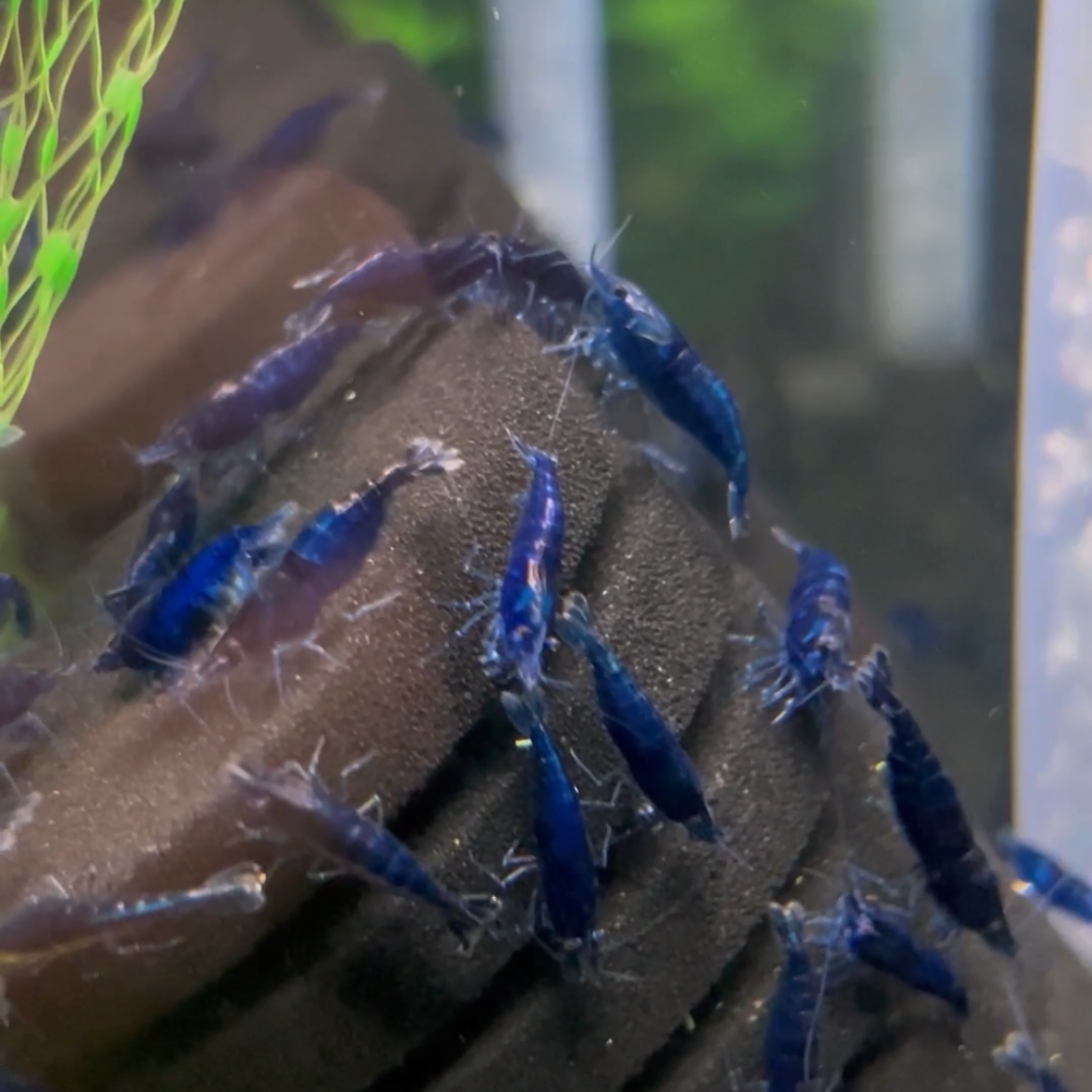
Their defining feature is pigment. Some individuals appear medium blue, while others develop deep navy coloration that can look almost black under dim lighting. Females are often larger and more heavily pigmented than males, while mature males tend to be slimmer and somewhat more translucent.
If you want to learn how to distinguish mature males from females before building a breeding colony, our Male vs. Female Neocaridina Shrimp Guide explains body shape, saddles, coloration, egg carrying, and other useful clues.
Blue Dream Shrimp Water Parameters
Blue Dream Shrimp thrive in stable water parameters with a pH between 7.0–7.8, GH of 7–8 dGH, KH of 3–4 dKH, TDS of 200–250 ppm, and temperatures of 65–74°F. While adaptable to broader Neocaridina ranges, avoiding parameter swings and maintaining zero ammonia and nitrite is essential for molting and breeding success.
Blue Dream Shrimp are more forgiving than many sensitive Caridina, but they still perform best when water chemistry remains predictable.
The current Shrimp Up Aquatics Blue Dream systems are maintained around:
| Parameter | Our Blue Dream Systems |
|---|---|
| pH | 7.0–7.8 |
| GH | 7–8 dGH |
| KH | 3–4 dKH |
| TDS | 200–250 ppm |
| Temperature | 65–74°F |
| Ammonia | 0 ppm |
| Nitrite | 0 ppm |
These are the conditions used in our systems, not numbers every aquarium must match exactly. The broader Neocaridina collection can be maintained across a wider suitable range. The main rule is to avoid repeatedly forcing the tank toward a different target.
A stable pH of 7.2 is generally more useful than water that swings dramatically because additives are being used every few days. The same principle applies to GH, KH, TDS, and temperature.
For a full explanation of how these measurements interact, read our Neocaridina Shrimp Water Parameters Guide.
Why GH and KH Matter for Blue Dream Shrimp
GH and KH are two of the most useful measurements in a Neocaridina aquarium.
GH, or general hardness, reflects dissolved minerals that include calcium and magnesium. Shrimp repeatedly build and shed an exoskeleton as they grow, so an appropriate mineral environment matters for successful molting.
KH, or carbonate hardness, contributes to buffering and helps resist sudden changes in pH.
You do not need to constantly add calcium products just because shrimp molt. Test the water first. If GH is already appropriate and molts are successful, adding more minerals can push the system away from the stable conditions you are trying to maintain.
What TDS Should Blue Dream Shrimp Have?
TDS is useful for monitoring consistency, especially when preparing replacement water, but it should not be treated as a complete description of water chemistry.
Two water samples can have the same TDS while containing different dissolved minerals.
Use TDS alongside GH, KH, pH, and your knowledge of the water source. If your tank normally runs near 220 ppm and replacement water suddenly measures 400 ppm, investigate the difference before performing a large water change.
Best Temperature for Blue Dream Shrimp
Blue Dream Shrimp do not need tropical-fish-level heat to thrive. Our systems are maintained around 65–74°F, which also helps avoid unnecessarily accelerating metabolism.
Temperature is especially relevant when breeding is the goal. A study published in The Biological Bulletin examined female Neocaridina davidi maintained at 28°C and 33°C. Females spawned at 28°C, while ovarian maturation and spawning were inhibited at the much higher 33°C treatment.
That does not establish one exact aquarium temperature for every Blue Dream colony, but it does reinforce a practical point: hotter is not automatically better for breeding. Avoid chasing reproduction by overheating the tank.

Blue Dream Shrimp Tank Size
A 5-gallon aquarium can support a Blue Dream colony when it is mature and stable, but a 10-gallon tank is often easier for newer keepers.
The extra water volume provides more stability while still remaining compact enough to function as a dedicated shrimp tank.
A practical Blue Dream setup includes:
- A fully cycled 5- to 10-gallon-or-larger aquarium
- A mature sponge filter or another shrimp-safe filter
- Plants and moss
- Driftwood or shrimp-safe rock
- Stable GH, KH, pH, TDS, and temperature
- Zero ammonia
- Zero nitrite
- Established biofilm and natural grazing surfaces
Best Filter for Blue Dream Shrimp
Sponge filters are one of the easiest filtration choices for a dedicated Blue Dream colony.
They provide biological filtration, gentle flow, oxygenation, and a large grazing surface while reducing the risk of tiny shrimplets being pulled into an intake.
Hang-on-back and canister filters can also work, but the intake should be protected with a pre-filter sponge or another shrimp-safe guard.
Whatever filter you choose, do not replace all biological media at once. Established media is part of the biological stability of the tank.
Blue Dream Shrimp Need a Fully Cycled Tank
Do not use Blue Dream Shrimp to cycle a new aquarium.
Before adding livestock, ammonia and nitrite should both remain at zero and the biological filter should already be established.
A mature tank is even better than a newly cycled one because the surfaces have had time to develop biofilm, microorganisms, and natural grazing.
If the aquarium is brand new, wait. Buying the shrimp after the tank is ready is far cheaper and easier than trying to rescue a colony from an unstable system.
Biofilm Is One of the Most Important Parts of Blue Dream Care
A research study in Aquaculture Research investigated the role of biofilm in the life cycle of Neocaridina davidi. Juvenile survival, biomass, and biochemical reserves were higher when biofilm-rich substrates were present, and females in those systems showed ovarian maturation and egg incubation.
That makes biofilm more than an aesthetic side effect of an older tank. It is a real food resource and can be especially important for shrimplets.
Useful biofilm surfaces include:
- Sponge filters
- Moss
- Plant leaves
- Driftwood
- Rock
- Substrate
- Botanicals
- Aquarium glass
Do not sterilize every surface during routine cleaning. A shrimp tank should be clean enough to maintain water quality while still remaining biologically mature.
What Do Blue Dream Shrimp Eat?
Blue Dream Shrimp naturally graze on biofilm, microorganisms, soft algae, decaying plant material, and fine organic particles.
A mature aquarium provides part of the diet, but an established colony still benefits from appropriately portioned supplemental food.
A varied feeding routine can include:
- Quality shrimp pellets or wafers
- Spirulina- and algae-based foods
- Botanicals
- Occasional appropriate protein
- Mature natural biofilm
If you need feeding options, browse shrimp food and botanicals.
The most common feeding mistake is overfeeding. Uneaten food breaks down, adds organic waste, and can hurt the water quality you worked to stabilize.
Best Plants for Blue Dream Shrimp
Live plants are not mandatory, but they make a Blue Dream aquarium much easier to structure.
Useful options include:
- Java Moss
- Anubias
- Java Fern
- Cryptocoryne
- Bucephalandra
- Other shrimp-safe freshwater plants
Moss is particularly useful for breeding colonies because it creates dense cover and microscopic grazing surfaces for newborn shrimp.
Blue Dream coloration also looks especially strong against bright green plants. If you are still building the tank, browse live aquatic plants.
Blue Dream Shrimp Tank Mates
Blue Dream Shrimp are peaceful, but the safest tank mate is not simply any fish labeled “peaceful.”
Adult shrimp can coexist with some small, non-aggressive fish, snails, and other compatible invertebrates. However, almost any fish that can fit a newborn shrimplet into its mouth may eat it.
If the primary goal is breeding, a shrimp-only tank is the simplest and most productive setup.
If the primary goal is a community display, choose small peaceful fish, provide dense moss and plants, and accept that baby survival will usually be lower.
Generally Better Tank-Mate Categories
- Freshwater snails
- Very small peaceful nano fish
- Other Blue Dream Shrimp
Tank Mates to Avoid
- Large predatory fish
- Aggressive territorial fish
- Fish large enough to swallow adult shrimp
- Any setup where maximum shrimplet survival is the priority
Can Blue Dream Shrimp Live With Other Neocaridina Colors?
Yes, but they can interbreed.
Blue Dream, Fire Red, Yellow, Orange, Green Jade, Blue Velvet, and other Neocaridina color morphs belong to the same species complex used in the aquarium hobby. Mixing those lines may create interesting offspring at first, but later generations can become less predictable and may trend toward translucent, brown, or wild-type coloration.
If you want to maintain a recognizable Blue Dream breeding line, keep the colony separate from other Neocaridina colors.
How to Acclimate Blue Dream Shrimp
Shipping water may differ significantly from the destination aquarium in temperature, pH, GH, KH, and TDS.
A gradual acclimation helps reduce the speed of that transition.
Our verified Freshwater Shrimp Acclimation Guide covers the complete process, including temperature acclimation and gradual introduction of aquarium water before transfer.
Have the tank ready before the shipment arrives. Acclimation cannot compensate for an uncycled aquarium.

How to Breed Blue Dream Shrimp
Blue Dream Shrimp reproduce entirely in freshwater, which is one of the major advantages of keeping Neocaridina.
A mature female develops eggs in the ovaries, often visible as a “saddle” behind the head. After mating, fertilized eggs are transferred beneath the abdomen, where the female carries and fans them until miniature shrimplets hatch.
The babies do not need brackish water or a separate larval rearing system. They emerge as tiny shrimp and immediately begin grazing throughout the aquarium.
For the full reproductive process, use our Complete Neocaridina Shrimp Breeding Guide.
Best Blue Dream Shrimp Breeding Setup
A productive breeding tank does not need to be complicated.
Focus on:
- A mature, fully cycled aquarium
- Stable water chemistry
- Gentle sponge filtration
- Dense moss or similar shrimplet cover
- Abundant biofilm
- No predatory fish
- Controlled feeding
- A healthy mix of mature males and females
Once the tank is working, resist the urge to constantly change it. Stable colonies generally benefit from repeatable maintenance rather than frequent “improvements.”
How Many Blue Dream Shrimp Should You Start With?
For a display colony, 10 shrimp is a practical starter group for many 5- to 10-gallon-or-larger aquariums. It gives you enough animals to see throughout the tank and provides a reasonable chance of receiving both sexes.
If your main goal is breeding, the current Blue Dream Breeder Pack is designed specifically for colony formation and consists of 7 females and 3 males, for 10 shrimp total.
If you want faster visual impact or a larger genetic starting population, the 20-shrimp pack is another option when the aquarium is mature enough to support it.
How Quickly Will a Blue Dream Colony Grow?
Colony growth depends on temperature, food, female maturity, water stability, tank mates, and shrimplet survival.
A field study published in Crustacean Research documented seasonal spawning and recruitment in wild Neocaridina davidi. Aquarium conditions are different from a natural river, but the research reinforces that reproduction is part of the species' normal life history rather than an unusual event.
In a stable aquarium without fish predation, once multiple mature females begin producing young, population growth can accelerate quickly.
What Do Blue Dream Shrimp Babies Need?
Newborn Blue Dream Shrimp need the same stable water as the adults but benefit disproportionately from dense mature surfaces covered in microscopic food.
That is why moss, sponge filters, wood, botanicals, and mature substrate are so valuable.
Avoid excessively cleaning the entire tank at once. The baby shrimp are tiny and spend much of their time grazing in places you may barely notice.
Will Blue Dream Babies All Be Dark Blue?
No line produces perfectly identical offspring forever.
Even within a Blue Dream colony, color intensity can vary. Some juveniles may develop darker pigment than others as they mature.
If your goal is to improve a line over multiple generations, keep the colony isolated from other Neocaridina colors and select your strongest breeders carefully.
Common Blue Dream Shrimp Care Mistakes
Adding Shrimp to an Immature Tank
Clear water does not mean cycled water. Confirm ammonia and nitrite are zero before adding livestock.
Chasing pH Constantly
Repeatedly adjusting pH can create the instability you are trying to prevent.
Ignoring GH and KH
pH is not the only important measurement. Mineral balance and buffering matter too.
Overfeeding
Extra food becomes extra waste. Feed for the actual colony size.
Using an Unprotected Filter Intake
Baby shrimp can be pulled into conventional intakes. Use a sponge filter or pre-filter protection.
Keeping Them With Predatory Fish
A fish may be peaceful toward other fish and still eat shrimp.
Mixing Color Lines When You Want Pure Blue Offspring
Different Neocaridina colors can interbreed, making offspring increasingly unpredictable.
Overheating the Tank to Force Faster Breeding
Higher temperature is not automatically better. Excessive heat can impair reproduction and increases metabolic demand.
Blue Dream Shrimp Care Checklist
| Care Area | Best Practice |
|---|---|
| Tank | 5–10 gallons or larger, fully cycled |
| Filter | Mature sponge filter or protected intake |
| pH | Keep stable within an appropriate Neocaridina range |
| GH/KH | Maintain adequate minerals and buffering consistently |
| Ammonia/Nitrite | 0 ppm |
| Plants | Moss plus live plants for grazing and cover |
| Feeding | Small portions plus mature biofilm |
| Breeding Tank Mates | Shrimp-only for maximum shrimplet survival |

Blue Dream Shrimp FAQ
Are Blue Dream Shrimp easy to care for?
Yes. They are among the more beginner-friendly ornamental freshwater shrimp when kept in a fully cycled aquarium with stable Neocaridina-appropriate water.
What pH do Blue Dream Shrimp need?
The current Shrimp Up Aquatics Blue Dream systems run around pH 7.0–7.8. Do not chase one exact value if your aquarium is stable within an appropriate range.
What temperature is best for Blue Dream Shrimp?
Our systems are maintained around 65–74°F. Avoid excessively hot water simply to accelerate breeding.
Can Blue Dream Shrimp live with fish?
Some small peaceful fish can coexist with adult shrimp, but newborn shrimplets can be eaten. A shrimp-only tank is best for maximum breeding success.
Do Blue Dream Shrimp eat algae?
They graze on soft algae and biofilm but should not be treated as a replacement for filtration, controlled feeding, or aquarium maintenance.
How many Blue Dream Shrimp should I buy?
A group of around 10 is a practical starting colony. If breeding is the priority, the Shrimp Up Aquatics breeder pack contains 7 females and 3 males.
Do Blue Dream Shrimp breed in freshwater?
Yes. Females carry eggs beneath the abdomen until miniature fully formed shrimp hatch directly into freshwater.
How can I tell male and female Blue Dream Shrimp apart?
Mature females are usually larger, broader through the abdomen, and more heavily pigmented. Males tend to be slimmer and lighter. Saddles or carried eggs are strong indicators of females.
Can Blue Dream Shrimp breed with Cherry Shrimp?
Yes. Both are Neocaridina color morphs and can interbreed. Keep Blue Dreams in a dedicated tank if preserving the blue line is important.
Start With the Right Tank—and the Right Starter Group
Blue Dream Shrimp are forgiving enough for newer keepers but rewarding enough to become a serious breeding project.
The formula is straightforward: cycle the aquarium completely, establish mature biofilm, keep GH, KH, pH, TDS, and temperature stable, use shrimp-safe filtration, feed responsibly, acclimate gradually, and keep predatory fish away from the breeding colony.
Once those fundamentals are in place, you can choose the starting group that matches your goal.
- 5 shrimp: useful for adding to an existing Blue Dream colony.
- 10 shrimp: a practical starter group for many dedicated tanks.
- 20 shrimp: stronger immediate visual impact and a larger starting population.
- Breeder Pack: 10 shrimp with a planned 7-female/3-male ratio for hobbyists focused on colony production.
Shop Blue Dream Shrimp Starter Groups →
100% Live Arrival Guarantee | Shipped Direct from Our Breeding Facility
If you want to compare Blue Dream with other Neocaridina colors before choosing, browse the complete Neocaridina Shrimp collection.
Sources & References
Aquaculture Research — Breeding and life cycle of Neocaridina davidi in a biofilm-based culture system — Peer-reviewed research on biofilm, reproduction, juvenile survival, growth, and the complete Neocaridina life cycle.
The Biological Bulletin — Losing Reproduction: Effect of High Temperature on Female Neocaridina davidi — Peer-reviewed research examining the effects of elevated temperature on ovarian maturation, spawning, and egg quality.
Crustacean Research — Life history of Neocaridina davidi in the Tomoe River — Research on spawning season, recruitment, size structure, and lifespan in a wild population.