

The best live plants for a Red Cherry Shrimp tank do more than make the aquarium look natural. Their leaves, stems, roots, and mossy surfaces give biofilm and microalgae more places to grow—and that is what Cherry Shrimp spend most of the day grazing.
Red Cherry Shrimp usually are not eating healthy plant leaves. They are picking at the microscopic food growing across those leaves.
If you are building a planted shrimp aquarium from scratch, these are 10 of the best plants for creating grazing surface, hiding places, and shrimplet cover.
If your planted tank is already cycled and mature, you can also browse our red cherry shrimp for sale.
1. Java Moss — Best Overall Plant for Cherry Shrimp
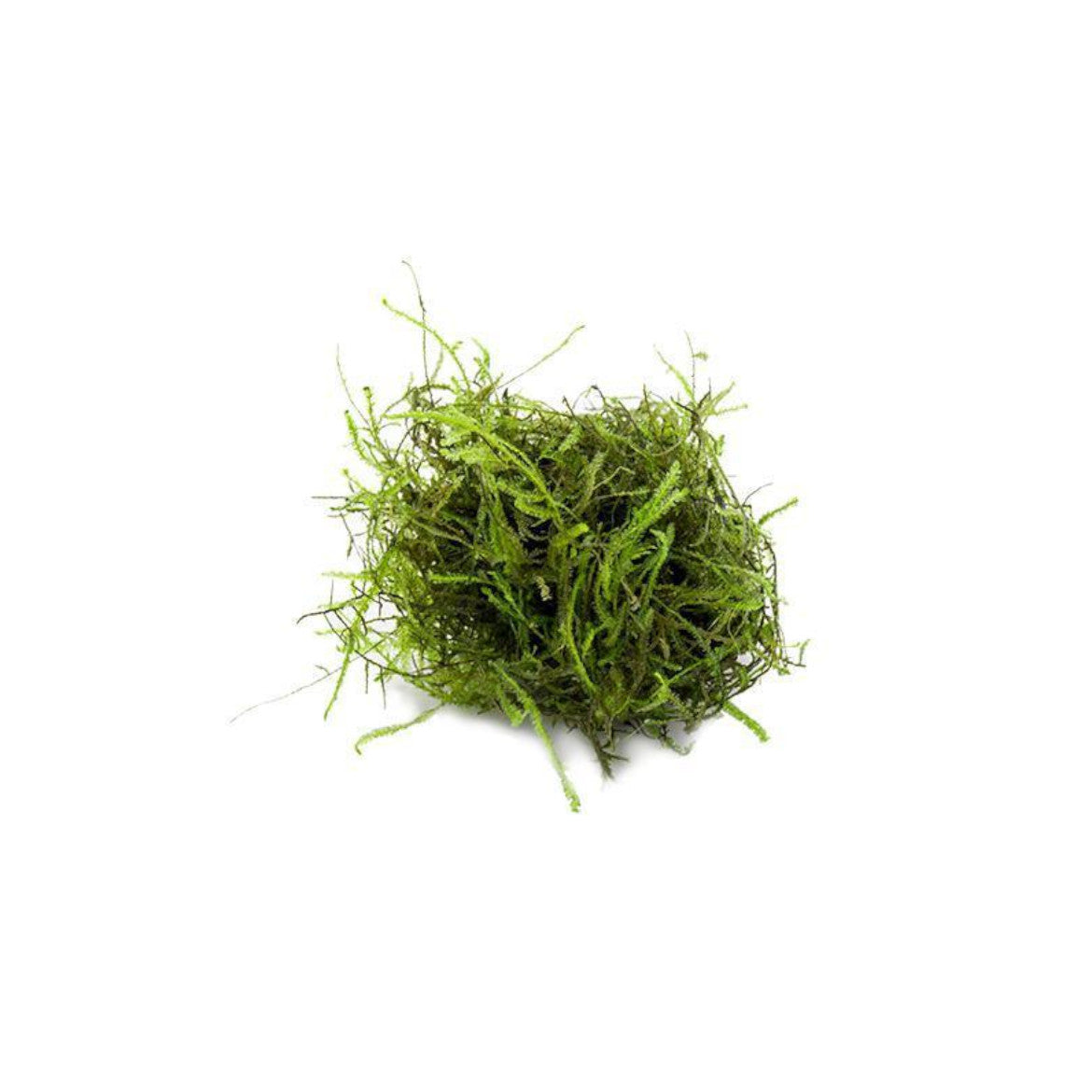
Java Moss is my first choice for a shrimp tank. Its dense branching structure creates an enormous amount of grazing surface in a small area while giving newborn shrimplets places to hide and feed.
A 2022 study on Neocaridina davidi found the highest juvenile survival in the treatment using Vesicularia moss compared with several other tested substrates. The authors suggested the moss-associated environment and periphytic community may have contributed to the benefit.
For a simple low-maintenance setup, Java Moss for Cherry Shrimp is difficult to beat.
2. Christmas Moss
Christmas Moss offers many of the same advantages as Java Moss but develops a more structured branching pattern. Shrimp can graze through the fine moss while tiny babies remain protected inside it.
3. Subwassertang
Subwassertang forms loose tangled masses with a huge amount of surface area. It is especially useful in breeding tanks because shrimplets can disappear into the plant while still having constant access to biofilm.
4. Guppy Grass
Guppy Grass grows into a dense web of stems and leaves. It can float or be loosely planted, making it useful when you want fast-growing cover without a complicated aquascape.
5. Water Wisteria
Water Wisteria develops highly divided leaves that create many edges and surfaces for shrimp to explore. It is a strong choice for hobbyists searching for live plants for a shrimp tank that also fill empty background space quickly.
6. Anubias
Anubias has broad, slow-growing leaves that are excellent visible grazing platforms. Because the leaves remain in the aquarium for a long time, they can develop mature biofilm that shrimp repeatedly revisit.
Attach the rhizome to rock or wood rather than burying it deeply.
7. Java Fern
Java Fern works for the same reason Anubias does: durable leaves create long-lived surfaces for biofilm. It also adds vertical structure without requiring a dense carpet or nutrient-heavy substrate.
8. Bucephalandra
Bucephalandra is another slow-growing epiphyte with firm leaves that shrimp constantly inspect. It is especially good in display tanks where you want both detail and easy-to-see grazing behavior.
9. Monte Carlo — Best Carpeting Plant for Shrimp
Monte Carlo can turn the foreground into thousands of tiny leaves and stems. A mature carpet creates a huge lower-level grazing zone while still keeping bright red shrimp visible.
If you specifically want a Monte Carlo shrimp tank, our Monte Carlo live aquarium plants are sold as three potted plants.

10. Hornwort
Hornwort's fine branching growth creates extensive surface area and cover. It can also be floated, which makes it useful in simple breeder tanks where function matters more than a formal aquascape.
Why Live Plants Help Cherry Shrimp Graze
Plants are valuable because every submerged surface can develop biofilm. Research on Neocaridina davidi has shown that biofilm can support growth, reproduction, and juvenile survival.
That is why a mature planted aquarium often provides more continuous natural grazing than a newly cycled bare tank.
Our Red Cherry Shrimp feeding guide explains how biofilm fits into a complete diet, while the baby Cherry Shrimp feeding guide covers shrimplet grazing in more detail.

Best Plant Combination for a Red Cherry Shrimp Tank
For a simple setup, combine:
- Java Moss for shrimplets
- Anubias or Java Fern for broad long-lived grazing surfaces
- Monte Carlo for foreground grazing
- Guppy Grass or Hornwort for dense upper-level cover
You do not need all 10 plants in one aquarium. A few mature, healthy plants are more useful than overcrowding the tank.
Choose substrate and planting style carefully as well. Our Cherry Shrimp substrate guide explains how sand, gravel, and aquasoil affect a planted setup.
Do Cherry Shrimp Eat Live Aquarium Plants?
Healthy Red Cherry Shrimp generally graze on plants rather than consuming healthy plants as their main food. They pick at biofilm, algae, microorganisms, and deteriorating organic material on the plant surface.
If a leaf is already dying or melting, shrimp may spend much more time grazing it.
What Is the Best Plant for Baby Cherry Shrimp?
Java Moss is the strongest all-around choice because its fine structure creates both feeding surface and physical cover. Dense moss gives tiny shrimplets places larger tank mates cannot easily reach.
Can You Add Plants and Shrimp at the Same Time?
It is better to establish the plants first and allow the aquarium to mature. That gives biofilm time to develop before the shrimp arrive.
Our Cherry Shrimp cycling guide explains the difference between a tank that can process ammonia and one that has developed useful mature grazing surfaces.
Once the plants are established and the tank is stable, you can buy Red Cherry Shrimp online for the finished setup.

Sources & References
FAO AGRIS — Effect of different substrates on growth and biochemical composition of Red Cherry Shrimp — Research comparing Vesicularia moss, Ceratophyllum, Cabomba, and artificial substrate in juvenile Neocaridina davidi.
FAO AGRIS — Breeding and life cycle of Neocaridina davidi in a biofilm-based culture system — Research showing the importance of biofilm-associated surfaces for juvenile survival, growth, and reproduction.