

The best substrate for Red Cherry Shrimp is usually a dark, inert aquarium sand or fine inert gravel that supports your aquascape without constantly changing pH, GH, or KH.
Red Cherry Shrimp are Neocaridina, and they generally do best when their mineral-rich water stays stable. That means the substrate should work with your intended water chemistry—not fight against it.
Active aquasoils can grow plants extremely well and can be useful in carefully planned aquascapes, but many are designed to lower and buffer pH. That chemistry is often more useful for soft-water Caridina than for a typical Red Cherry colony.
If your aquarium is cycled and your substrate plan is already stable, browse our red cherry shrimp for sale. Our current Fire Red Cherry Shrimp are approximately 1/2–1 inch and breeding age, with 1-, 5-, 10-, 20-shrimp and breeder-pack options.
Best Substrate for Cherry Shrimp: Quick Answer
| Substrate | Red Cherry Shrimp Rating | Best Use |
|---|---|---|
| Dark Inert Sand | Excellent | Display tanks, low-tech planted tanks, strong red contrast |
| Fine Inert Gravel | Excellent | Breeding tanks, planted aquascapes, easy maintenance |
| Inert Planted Substrate | Excellent | Rooted plants without intentional pH buffering |
| Active Aquasoil | Conditional | Advanced planted setups where its chemistry is intentionally planned |
| Light Sand | Good | Bright natural aquascapes; weaker visual contrast with red shrimp |
| Very Coarse Gravel | Usable | Simple tanks, but debris can settle deeply between large particles |
Our default recommendation for most Red Cherry Shrimp keepers: choose a dark inert substrate with a small-to-medium grain size, then supply rooted plants with appropriate fertilizers or root tabs if needed.
This keeps your substrate choice simple while letting your source water, remineralizer, and maintenance routine determine the shrimp's mineral chemistry.

What Does “Inert Substrate” Mean?
An inert aquarium substrate is selected specifically because it does not intentionally buffer or substantially alter your water chemistry.
Common inert choices include:
- Aquarium sand
- Quartz-based sand
- Fine aquarium gravel
- Dark decorative gravel confirmed safe for aquarium use
- Some planted substrates marketed as chemically inert
Always verify the specific product. The word “black,” “natural,” or “plant substrate” does not automatically mean inert.
For Red Cherry Shrimp, inert substrate is attractive because it removes one major variable from the aquarium.
If your source water is already around a suitable Neocaridina range, an inert substrate lets you maintain that water without the substrate constantly trying to pull the chemistry somewhere else.
Why Dark Substrate Is Especially Good for Red Cherry Shrimp
Dark substrate is not mandatory, but it is one of the strongest choices for a Fire Red aquascape.
The obvious reason is contrast.
Bright red shrimp stand out dramatically against:
- Black sand
- Dark brown gravel
- Charcoal-colored planted substrate
- Dark rock
- Deep green plants
But there is also research suggesting that background color can influence how Red Cherry Shrimp express visible pigmentation.
A peer-reviewed study in the Journal of the World Aquaculture Society raised juvenile Neocaridina davidi against black, red, and white backgrounds. Females exposed to black backgrounds developed greater astaxanthin content and a greater relative colored area of the carapace than shrimp exposed to lighter backgrounds.
That does not mean black sand changes a poor genetic line into Fire Red grade. Genetics still set the basic color potential. But background can influence both visual contrast and pigment expression.
Red Cherry Shrimp Also Show a Preference for Dark Backgrounds
A separate study published in Animals tested red, brown, and white Neocaridina davidi morphs against differently colored backgrounds.
All three color morphs preferred darker backgrounds over white, and the red morph also showed strong preference for coarse-patterned dark backgrounds.
Again, the experiment used controlled background panels rather than bags of aquarium gravel, so it should not be exaggerated into a claim that every Cherry Shrimp “must” live on black sand.
The practical conclusion is simpler: dark substrate is biologically reasonable, visually effective, and especially attractive for a Red Cherry display.
Is Sand Good for Red Cherry Shrimp?
Yes.
Inert aquarium sand is one of the easiest substrate choices for Red Cherry Shrimp.
Advantages include:
- Minimal effect on water chemistry when truly inert
- Strong visual contrast in dark colors
- Easy observation of shrimp and shrimplets
- Food stays near the surface instead of falling deeply between large stones
- Works well with moss, epiphytes, wood, and rocks
- Can support many rooted plants when nutrition is supplied appropriately
Potential Sand Downsides
Very fine sand can compact more than gravel, especially when used in an unnecessarily deep layer.
Rooted plants can also require additional nutrition because plain inert sand contains little or no fertilizer.
Those are manageable issues. Use reasonable depth, avoid burying excessive organic waste, and fertilize rooted plants according to their needs.
Is Gravel Good for Cherry Shrimp?
Yes.
Fine inert gravel is arguably the easiest all-around choice for a shrimp aquascape.
It provides:
- Good plant anchoring
- Plenty of textured grazing surface
- Easy water movement through the upper substrate
- Long lifespan
- Minimal chemistry manipulation when truly inert
The ideal gravel is not extremely coarse.
Large gravel gaps allow food and detritus to fall deep below the surface, where they become harder to remove.
For a Red Cherry tank, a smaller grain usually creates a cleaner, more proportional nano-aquarium appearance.
Sand vs. Gravel for Red Cherry Shrimp
| Feature | Sand | Fine Gravel |
|---|---|---|
| Water Chemistry | Neutral if inert | Neutral if inert |
| Debris Visibility | Usually stays near surface | Some debris settles between grains |
| Rooted Plants | Good with proper nutrition | Very good anchoring |
| Shrimp Grazing | Excellent surface access | Excellent textured surface |
| Maintenance | Easy surface siphoning | May need gentle vacuuming between grains |
There is no universal winner. Choose the look and maintenance style you prefer.
What Is Active Aquasoil?
Active aquasoil is different from inert sand or gravel because it is designed to interact with aquarium water.
Many aquasoils are made from processed natural soil or clay and are developed primarily for planted aquariums.
They may:
- Lower pH
- Buffer water toward an acidic range
- Alter carbonate hardness
- Provide nutrients to rooted plants
- Release ammonium or other nitrogen compounds during initial setup depending on the formulation
This is not a defect. It is the reason these substrates exist.
For example, Aqua Design Amano's official Aqua Soil information states that its natural-soil substrate adjusts water toward slightly acidic conditions while providing nutrients for aquatic plants.
ADA's published technical research also demonstrates measurable pH-lowering and buffering behavior in Amazonia.
Is Aquasoil Bad for Red Cherry Shrimp?
No—but it should be chosen intentionally.
A fully cycled, stable aquarium using active substrate can keep Red Cherry Shrimp successfully when the resulting water chemistry remains appropriate.
The problem is using active aquasoil without understanding what it does.
Imagine your tap water naturally gives you:
- pH 7.4
- GH 7
- KH 4
Those parameters are already very close to the current Shrimp Up Aquatics Fire Red system.
If you add a strongly buffering substrate specifically designed to lower pH and carbonate hardness, you may create a chemistry battle that did not exist before.
For a beginner Red Cherry tank, simplicity usually wins.
When Active Aquasoil Can Make Sense
Active substrate can still make sense when:
- You are building a high-tech planted aquascape.
- You understand exactly how the chosen soil affects pH and KH.
- Your source water and remineralization plan are built around that substrate.
- You are willing to cycle the substrate completely before adding shrimp.
- You monitor ammonia and nitrite carefully during setup.
Do not add livestock based only on how clear the water looks.
Some Aquasoils Can Release Ammonium During Setup
This is another reason active soil must be cycled before shrimp are introduced.
ADA's own published setup data for Amazonia Ver.2 shows elevated ammonium during the early phase of a newly established planted aquarium, followed by non-detectable ammonium later as the system matured.
Not every aquasoil behaves identically, so follow the manufacturer's instructions for the exact product you use.
Whatever substrate you select, ammonia and nitrite should be zero before Red Cherry Shrimp are added.
Best Substrate Color for Fire Red Cherry Shrimp
If your main goal is maximum visual impact, choose:
- Black
- Charcoal / dark gray
- Dark brown
These colors create strong contrast with Fire Red shrimp and bright green plants.
White or pale sand can create a beautiful minimalist aquascape, but the shrimp may appear less saturated against the light background and the red/white contrast can feel harsher than red against dark natural tones.
Best Substrate for a Planted Red Cherry Shrimp Tank
If plants are important, choose the substrate based on both shrimp chemistry and plant feeding strategy.
You have two straightforward options.
Option 1: Inert Substrate + Root Nutrition
This is our preferred beginner route.
Use dark inert sand or gravel, then supply demanding root-feeding plants with appropriate root tabs or other plant nutrition.
This gives you control over the nutrients without forcing the substrate to control pH.
Option 2: Active Plant Soil
This can produce outstanding plant growth, but you must build your water chemistry around the soil.
Do not assume “best substrate for plants” automatically means “best substrate for Red Cherry Shrimp.”
The best aquascape supports both.
Which Plants Work Well With Inert Substrate?
Many excellent shrimp plants do not require nutrient-rich soil at all.
Epiphytes and mosses can be attached to wood or rock, including:
- Java Moss
- Java Fern
- Anubias
- Bucephalandra
These plants get most of their nutrients from the water column rather than needing their rhizomes buried.
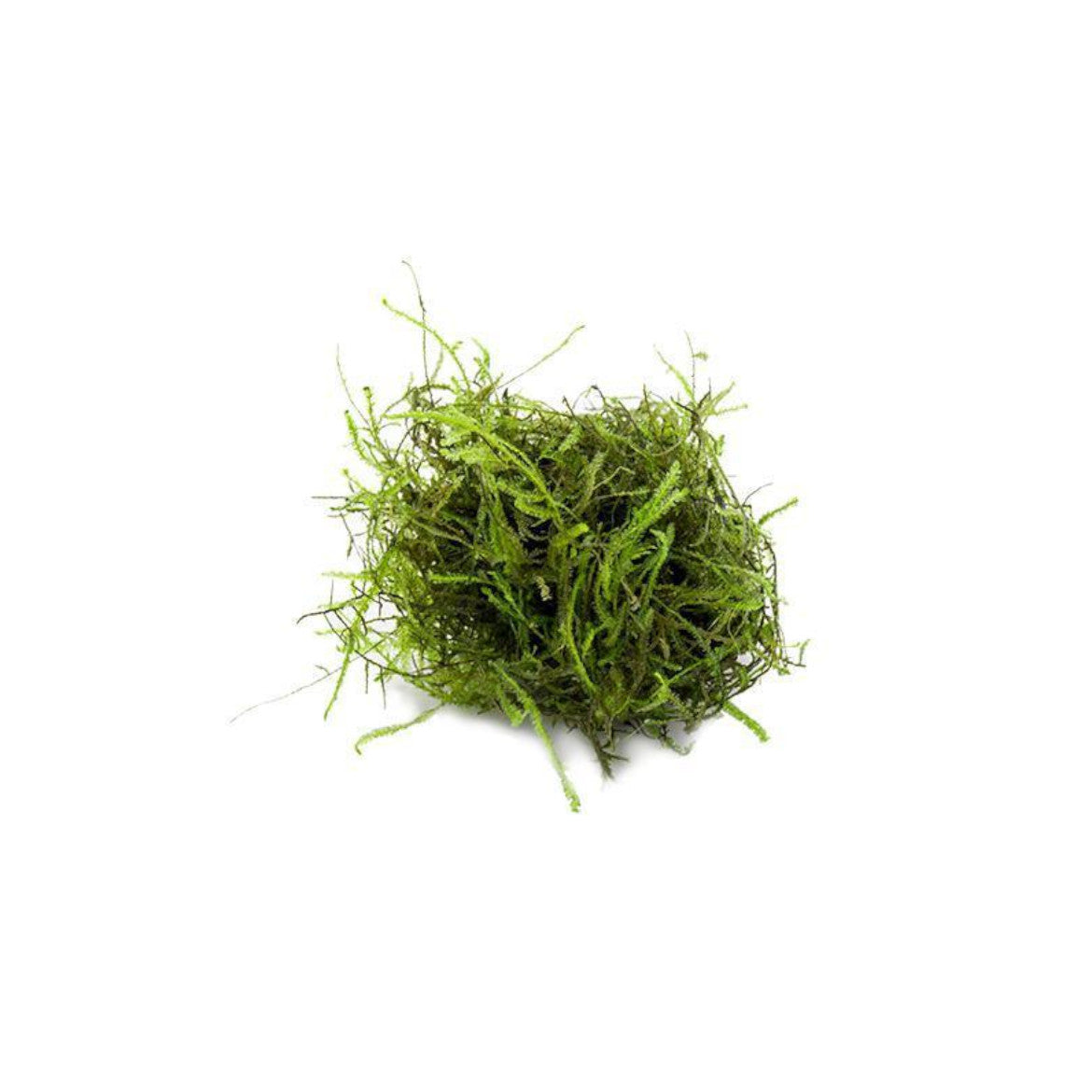
Java Moss is particularly useful in breeding tanks because its fine branching creates dense shrimplet cover and extensive grazing area.
You can browse our live aquarium plants when building the planted portion of your layout.
Can You Grow Carpeting Plants on Inert Substrate?
Yes.
Carpeting plants can grow over inert substrate when their light, CO2, and nutrient needs are met.
Our Micranthemum Monte Carlo is a foreground carpeting option that creates bright green contrast with Fire Red shrimp.
In an inert setup, rooted carpeting plants may benefit from targeted root nutrition and appropriate water-column fertilization.

How Deep Should Substrate Be?
There is no single shrimp-required depth because Red Cherry Shrimp do not depend on deep substrate for burrowing.
The depth is mostly determined by:
- Plant root requirements
- Aquascape slope
- Tank size
- Maintenance style
For a simple non-rooted moss and epiphyte tank, a shallow layer can be enough.
For a rooted planted aquascape, roughly 2–3 inches is a practical starting range in many tanks, often sloped higher toward the back to create visual depth.
Avoid adding excessive depth simply because more substrate looks “more natural.” Deep substrate increases the amount of material that can trap debris and makes major rescapes more disruptive.
What Grain Size Is Best?
Small-to-medium grains are easiest for most Cherry Shrimp aquascapes.
Very coarse gravel creates large gaps that trap food and detritus.
Ultra-fine sand looks clean but can compact heavily if laid extremely deep.
A moderate grain size gives you:
- Easy shrimp grazing
- Good plant anchoring
- Reasonable maintenance access
- A natural scale for nano aquariums
Does Substrate Grow Biofilm?
Yes.
Every submerged surface becomes potential microbial habitat as the aquarium matures.
That includes:
- Sand grains
- Gravel
- Aquasoil
- Rock
- Wood
- Plant leaves
- Filter sponges
Red Cherry Shrimp constantly graze these surfaces.
The best substrate is therefore not the one with a magical “biofilm ingredient.” It is one that remains stable while the entire aquarium matures.
Should You Vacuum Cherry Shrimp Substrate?
Yes, when necessary—but gently.
A shrimp tank should not be sterilized.
Remove excessive waste while preserving the mature biological environment.
With sand, hover a siphon just above the surface to remove loose debris.
With gravel, lightly vacuum selected areas rather than aggressively deep-cleaning the entire tank every week.
Be especially careful in breeding tanks because tiny shrimplets can be difficult to see.
Should You Use a Bare-Bottom Cherry Shrimp Tank?
Bare-bottom tanks can work extremely well for commercial breeding, quarantine, and high-maintenance production systems.
Advantages include:
- Easy waste removal
- Easy shrimp counting
- Easy observation
- No substrate chemistry
But for a home display aquascape, bare glass sacrifices much of the natural appearance and substrate grazing area.
If your goal is a beautiful planted Red Cherry aquarium, substrate is usually worth using.
Should You Cap Soil With Sand?
Dirted or soil-capped aquariums can grow plants extremely well, but they are less predictable than a simple inert substrate.
Disturbing the cap can release fine soil into the water. Organic soils can also create nutrient and ammonia issues during setup if they are not managed correctly.
For experienced planted-tank keepers, this can be a viable method.
For a first Red Cherry Shrimp aquascape, we would choose inert aquarium substrate and targeted plant nutrition instead.
Substrates to Be Careful With
Crushed Coral
Crushed coral is not inert. It can dissolve and increase hardness, alkalinity, and pH.
It can be useful when you intentionally need additional carbonate and calcium, but it should not be chosen simply because Cherry Shrimp need minerals.
Test GH and KH first.
Aragonite
Aragonite is commonly used in marine and hard-water systems because it can increase carbonate hardness and pH.
That makes it a poor default substrate for a standard Red Cherry aquascape unless you specifically need that chemistry.
Unknown Landscaping Gravel
Decorative landscaping gravel can contain limestone, metals, coatings, or other materials that were never intended for aquariums.
Use aquarium-safe substrate or a material whose composition you can verify.
Painted Decorative Gravel
Only use painted gravel specifically manufactured for aquarium use by a reputable source. Avoid unknown coatings that may degrade underwater.
How Substrate Interacts With GH and KH
Substrate selection becomes especially important when you are trying to maintain a specific mineral profile.
The current Shrimp Up Aquatics Fire Red Cherry systems are maintained around:
- pH: 7.0–7.8
- GH: 7–8 dGH
- KH: 3–4 dKH
- TDS: 200–250 ppm
- Temperature: 65–74°F
If your substrate actively removes carbonate hardness or lowers pH, those effects become part of your water-management plan.
If your substrate contains carbonate minerals and raises KH, that also becomes part of the plan.
An inert substrate is simpler because it lets you manage GH and KH through the water itself.
Our Neocaridina Shrimp Water Parameters Guide explains pH, GH, KH, TDS, and stability in detail.
Best Substrate for a Red Cherry Breeding Tank
For a dedicated breeding tank, function matters more than elaborate aquascaping.
We would use:
- Dark inert sand or fine gravel
- A mature sponge filter
- Java Moss or other dense plants
- Wood or rock for grazing
- Open feeding and observation space
This setup gives the shrimp plenty of biofilm while keeping the chemistry and maintenance easy to understand.
For the full colony setup, read our Complete Neocaridina Shrimp Breeding Guide.
Best Substrate for a Show Aquascape
For a display tank, choose substrate based on three priorities:
- Water chemistry
- Plant requirements
- Visual contrast
For most Fire Red displays, a dark inert planted substrate gives you the easiest balance.
It makes the shrimp pop visually while allowing you to build nutrient delivery around the plants instead of designing the entire shrimp chemistry around an active soil.
Our Neocaridina Shrimp Tank Aquascaping Guide covers plant placement, hardscape, viewing zones, moss, filtration, and shrimplet habitat in more detail.
Can Red Cherry Shrimp Live on White Sand?
Yes.
If the sand is aquarium-safe and chemically appropriate, Red Cherry Shrimp can live perfectly well on white substrate.
The main tradeoffs are visual.
White sand:
- Shows detritus quickly
- Creates a bright minimalist look
- Makes green plants stand out
- Can make some shrimp appear visually lighter than they do on dark substrate
Choose it because you like the aesthetic—not because it is biologically better.
Can Red Cherry Shrimp Live on Black Sand?
Yes, and black inert sand is one of our favorite display choices.
It provides strong contrast, works with almost every plant color, and does not intentionally change water chemistry when the sand is truly inert.
Can You Mix Sand and Gravel?
Yes, but they will often mix over time.
If you create a decorative sand path beside gravel, shrimp movement, maintenance, planting, and water flow can gradually blend the boundary.
Use rock dividers or hidden barriers if you want the two materials to remain visually separated.
Should Substrate Be Rinsed?
Follow the instructions for the exact product.
Many inert sands and gravels benefit from rinsing to remove dust.
Some active aquasoils are specifically intended to be used without aggressive rinsing because rinsing can damage granules or remove useful material.
Never assume all substrates have the same preparation requirements.
How Long Does Shrimp Substrate Last?
Inert sand and gravel can last indefinitely if they remain physically intact and you still like the layout.
Active substrates are different because their chemical buffering capacity changes with use.
That means an active substrate may continue to look physically fine even after its original chemistry effect has weakened.
For Red Cherry Shrimp, this is another advantage of inert substrate: there is no pH-buffering capacity that you must eventually replace.
Do Root Tabs Hurt Cherry Shrimp?
Use aquarium fertilizers according to the manufacturer's instructions and make sure the product is appropriate for a shrimp aquarium.
Root tabs are buried beneath the substrate so nutrients are concentrated near plant roots.
Do not crush or scatter concentrated fertilizer directly where shrimp can graze it.
If you use any fertilizer, monitor the aquarium rather than assuming “plant safe” automatically means unlimited dosing is harmless.
Red Cherry Shrimp Substrate FAQ
What is the best substrate for Cherry Shrimp?
For most Red Cherry/Neocaridina aquariums, dark inert sand or fine inert gravel is the easiest all-around choice because it supports stable water chemistry and creates strong visual contrast.
Do Cherry Shrimp need special substrate?
No. They do not require a branded “shrimp substrate.” The substrate should be aquarium-safe and appropriate for the water chemistry you intend to maintain.
Is black substrate better for Red Cherry Shrimp?
Black substrate creates excellent visual contrast, and controlled studies have found that dark backgrounds can influence Red Cherry Shrimp pigmentation and substrate preference. It is still not mandatory for health.
Is sand or gravel better for Cherry Shrimp?
Both work well when inert. Sand keeps debris near the surface, while fine gravel provides strong plant anchoring and textured grazing area.
Can Red Cherry Shrimp live on aquasoil?
Yes, if the aquarium is fully cycled and the resulting pH, GH, KH, and TDS remain appropriate. Active soil should be used intentionally because many products alter water chemistry.
Does aquasoil lower pH?
Many active soils do. The exact effect depends on the product. ADA, for example, documents pH-lowering and buffering behavior in its Aqua Soil products.
Can aquasoil release ammonia?
Some nutrient-rich aquasoils can release ammonium during initial setup. Follow the manufacturer's cycling instructions and verify 0 ppm ammonia and nitrite before adding shrimp.
How deep should substrate be in a Cherry Shrimp tank?
Shrimp themselves do not require deep substrate. For a rooted planted aquascape, roughly 2–3 inches is a practical starting range; simpler moss tanks can use less.
Can I use crushed coral as Cherry Shrimp substrate?
You can, but crushed coral can raise hardness, alkalinity, and pH. Use it only when that chemistry matches your water-management goal.
Do Cherry Shrimp eat from the substrate?
Yes. They constantly graze biofilm, microorganisms, algae, and fine organic material from substrate surfaces.
Can I change substrate with shrimp already in the tank?
Yes, but a full substrate replacement is a major disturbance. It can release debris, disturb plants, remove biological surface area, and alter chemistry. Plan the change carefully rather than replacing everything impulsively.
Build the Aquascape Around Stable Water First
A good Red Cherry Shrimp substrate should make the aquarium easier to maintain, not create another parameter you are constantly fighting.
For most keepers, the formula is simple:
dark inert sand or fine gravel + mature filtration + live plants + moss + stable Neocaridina water.
Use active aquasoil only when you specifically want the chemistry and plant-growing behavior that comes with it.
Choose dark substrate if you want Fire Red shrimp to stand out strongly. Add bright green plants for contrast. Leave open areas for observation and feeding. Give shrimplets moss and mature surfaces to graze.
If your tank is already cycled and stable, shop cherry shrimp for sale at Shrimp Up Aquatics.
If you are ready to build a larger starter colony, you can also buy cherry shrimp online in 1-, 5-, 10-, 20-shrimp or breeder-pack quantities.
For first-time keepers designing the entire aquarium—not just the substrate—read our Beginner's Guide to Keeping Neocaridina Shrimp.
