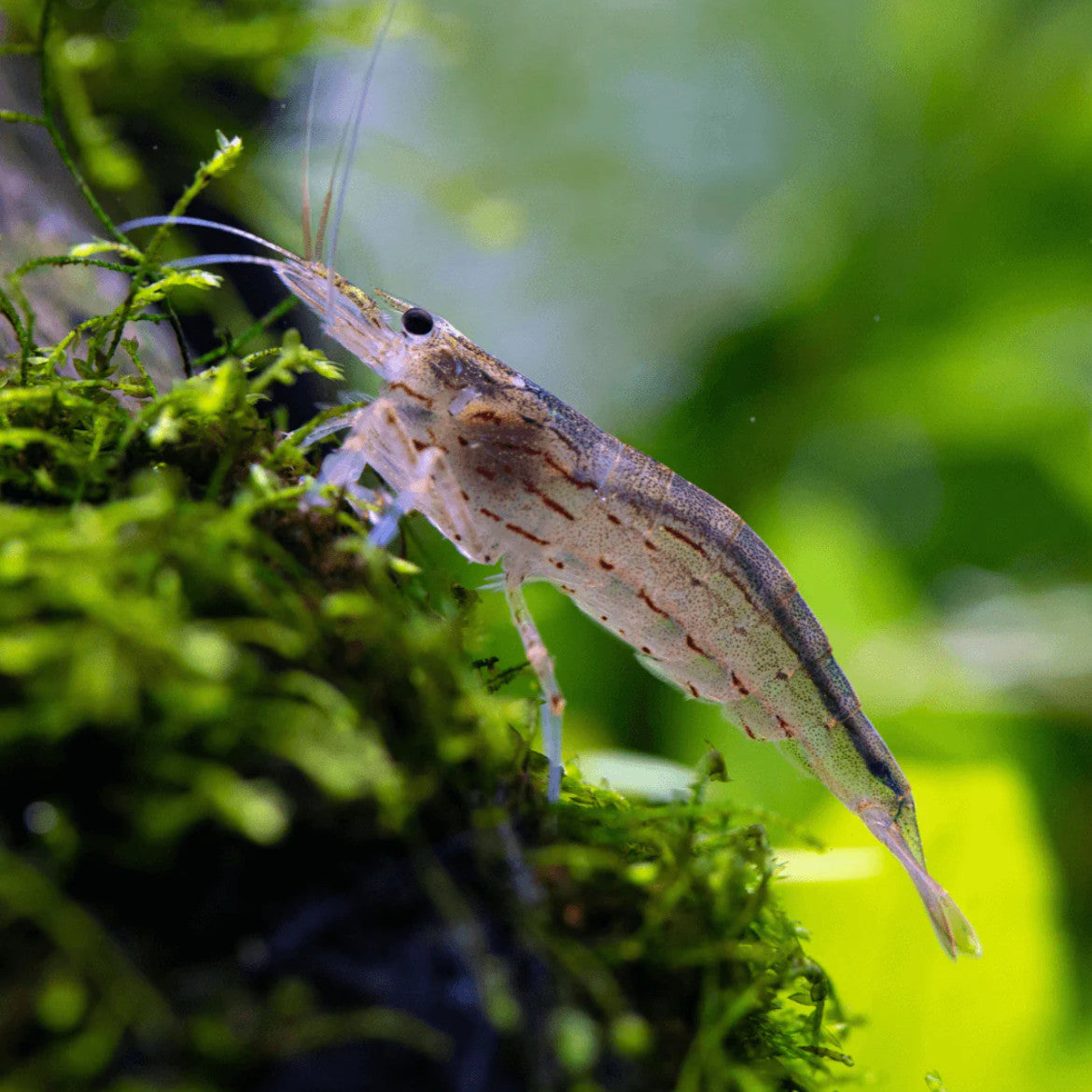
Amano Shrimp for Sale – Algae-Eating Freshwater Shrimp
Looking to buy Amano Shrimp online for a planted tank, aquascape, or peaceful freshwater aquarium? Amano Shrimp (Caridina multidentata) are famous for their nonstop grazing behavior and strong appetite for biofilm, soft algae, and leftover foods.
Unlike colorful Neocaridina, Amanos are valued less for bright pigmentation and more for their size, activity, hardiness, and usefulness in mature aquariums. Their mostly translucent bodies, dotted side pattern, and busy foraging behavior make them especially popular in planted tanks where natural cleanup and subtle appearance are both desirable.
Shipping SizeApproximately 1/2 to 1 inch.
Excellent GrazerConstantly searches surfaces for biofilm and soft algae.
Peaceful Freshwater ShrimpWorks well in many planted and community aquariums.
Flexible Pack SizesAvailable as 1, 5, or 10 shrimp.
Which Amano Shrimp pack should you choose?
-
1 shrimp: Best for adding an individual Amano to an existing aquarium.
-
5 shrimp: A useful group for a planted nano or medium aquarium.
-
10 shrimp: A larger cleanup group for bigger planted tanks or aquascapes with more grazing surface.
Choose your preferred quantity using the product options above this description.
Why Buy Amano Shrimp From Shrimp Up Aquatics?
-
Natural Algae Grazers that continuously forage across plants, hardscape, substrate, and aquarium glass.
-
Excellent Biofilm Feeders for mature planted aquariums.
-
Peaceful Temperament suited to many carefully selected freshwater community tanks.
-
Larger Than Most Dwarf Shrimp as they mature, making adults more visible and robust than many Neocaridina.
-
Plant-Safe Foraging that works especially well in aquascaped tanks.
-
No Freshwater Population Explosion because successful larval development requires brackish to marine conditions.
If you want to compare Amanos with other aquarium shrimp before ordering, browse our complete freshwater shrimp collection.
What Do Amano Shrimp Look Like?
Amano Shrimp have a mostly transparent to gray-brown body with a distinctive line of dots or dashes along the sides. Their understated coloration helps them blend naturally into planted aquariums while remaining easy to spot when actively grazing.
As they mature, Amanos can grow larger than typical Neocaridina shrimp. Females are generally larger and fuller-bodied than males. Adult females often show elongated dash-like markings along the sides, while males more commonly show smaller dot-like markings.
Our listed shrimp are approximately 1/2 to 1 inch at shipping. They can continue growing after arrival as they mature in a stable aquarium.
Amano Shrimp Water Parameters
Amano Shrimp are adaptable compared with many ornamental Caridina species, but stable water quality remains essential. Avoid sudden swings and always acclimate new shrimp gradually when your aquarium differs significantly from their shipping water.
| Parameter |
Recommended Range / Guidance |
| pH |
Approximately 6.0–8.0 |
| Temperature |
Approximately 65–82°F |
| GH |
Moderate to hard, mineralized freshwater |
| KH |
Stable; avoid rapid swings |
| TDS |
Use as a consistency check; avoid large sudden swings |
| Ammonia |
0 ppm |
| Nitrite |
0 ppm |
| Nitrate |
Keep controlled with routine maintenance |
Consistency is more important than chasing one exact number. Amano Shrimp need enough dissolved minerals for healthy molts, clean oxygenated water, and a mature biological filter. Use TDS alongside pH, GH, and KH as a consistency check rather than treating TDS as a standalone target.
Best Tank Setup for Amano Shrimp
A mature planted aquarium with stable water quality and plenty of grazing surface is ideal.
Tank Size
Amanos can live in smaller mature aquariums, but more water volume generally provides better stability and more area for grazing. Larger groups should be given enough space and food so they are not competing constantly at feeding time.
Filtration
Gentle, dependable filtration is important. A mature sponge filter provides biological filtration and an additional biofilm-covered grazing surface. Protect strong filter intakes so shrimp cannot be pulled into them.
Plants & Hardscape
Plants, moss, driftwood, and stone provide enormous amounts of surface area for natural grazing. Browse our live aquarium plants collection when building a planted Amano setup.
Secure Lid
Amano Shrimp are capable climbers and may leave an aquarium if conditions are poor or openings are easily accessible. Keep the tank covered and check gaps around cords, airline tubing, and filter equipment.
What Do Amano Shrimp Eat?
Amano Shrimp are famous algae grazers, but algae should not be their only food source. They also consume biofilm, microorganisms, decaying organic material, leftover fish foods, algae wafers, and shrimp-specific prepared diets.
| Food Source |
Typical Amano Interest |
| Biofilm |
Excellent natural grazing food |
| Soft algae films |
Frequently grazed |
| Hair / filamentous algae |
Often grazed, especially when other foods are limited |
| Decaying plant matter |
Commonly scavenged |
| Algae wafers & shrimp foods |
Readily accepted |
| Tough established algae |
Results vary; no shrimp replaces proper algae control |
Do not overfeed. Amanos are opportunistic and may choose richer prepared foods over algae when food is constantly available. They are useful cleanup animals, but they do not replace appropriate lighting, nutrient management, filtration, and routine maintenance.
For supplemental feeding, browse our shrimp food and botanicals.
Can Amano Shrimp Breed in Freshwater?
Amano Shrimp have a very different reproductive cycle from Neocaridina. Adult Amanos live in freshwater and females can carry large numbers of eggs, but the newly hatched larvae require brackish to marine conditions to develop successfully.
That means Amanos generally will not establish a self-reproducing population in a normal freshwater aquarium. This can be an advantage for aquarists who want active shrimp without a rapidly expanding colony.
Important: Amano Shrimp are Caridina multidentata, but their care and breeding requirements are very different from ornamental bee, crystal, and Taiwan Bee Caridina. Do not assume all Caridina need the same water chemistry.
Can Amano Shrimp Live With Fish?
Amano Shrimp can live with many peaceful nano and community fish, but any fish large enough to swallow or seriously harass a shrimp should be avoided.
Good community planning matters more than the species label alone. Provide plants, wood, rockwork, and hiding places so shrimp can retreat while molting. Small peaceful fish, snails, and many other non-aggressive aquarium inhabitants are generally better choices than cichlids or larger predatory fish.
Amano Shrimp vs. Cherry Shrimp
| Trait |
Amano Shrimp |
Cherry / Neocaridina Shrimp |
| Main appeal |
Algae grazing, larger size, natural appearance |
Bright colors and easy colony breeding |
| Adult size |
Generally larger |
Generally smaller |
| Freshwater breeding |
Larvae do not develop normally in freshwater |
Breed completely in freshwater |
| Color |
Transparent to gray-brown with spots/dashes |
Many selectively bred colors |
| Algae grazing reputation |
Excellent |
Useful but usually less aggressive grazers |
Amano Shrimp Price & Pack Options
Use the live product options above for current pricing. Amano Shrimp are available in:
- 1 shrimp
- 5 shrimp
- 10 shrimp
The right quantity depends on tank size, available grazing surface, existing livestock, and how much supplemental food is available.
Acclimating Amano Shrimp After Delivery
Shrimp can be sensitive to sudden changes in temperature and water chemistry. Gradual acclimation helps reduce stress as they transition from shipping water to your aquarium.
Follow our Freshwater Shrimp Acclimation Guide before releasing them into the tank.
Live Arrival & DOA Policy: Livestock orders are covered by our
Live Arrival Guarantee / DOA Policy. Review the policy before ordering for arrival, documentation, and claim requirements.
Ready to add Amano Shrimp to your aquarium?
Select your preferred 1, 5, or 10-shrimp pack above, then add your livestock to cart.
Amano Shrimp are especially useful in mature planted aquariums where they have plenty of surfaces to graze and peaceful tank mates.
Learn More About Amano Shrimp
Want a deeper guide before or after ordering? Start with these essential Amano Shrimp resources:
Amano Shrimp FAQ
Are Amano Shrimp good algae eaters?
Yes. Amano Shrimp are widely kept for their active grazing on biofilm, soft algae, and some filamentous algae. Their effectiveness still depends on tank conditions and what other foods are available.
Will Amano Shrimp completely clean algae from my aquarium?
No. They can be valuable members of a cleanup crew, but they cannot correct excessive lighting, nutrient imbalance, poor maintenance, or every type of algae.
How big are the Amano Shrimp when shipped?
Our current Amano Shrimp are approximately 1/2 to 1 inch at shipping and can continue growing as they mature.
How large do adult Amano Shrimp get?
Adult Amanos can reach roughly 1.5 to 2 inches, with females generally becoming larger and fuller-bodied than males.
Can Amano Shrimp breed in freshwater?
Adults can mate and females can carry eggs in freshwater, but the larvae require brackish to marine conditions to develop successfully. They generally do not form self-sustaining colonies in standard freshwater tanks.
Can Amano Shrimp live with Cherry Shrimp?
Yes. Amanos can live with Neocaridina such as Red Cherry Shrimp. Because Amanos are larger and assertive at feeding time, make sure smaller shrimp still receive enough food.
Will Amano Shrimp crossbreed with Neocaridina?
No. Amano Shrimp and Neocaridina are different species and do not crossbreed.
Do Amano Shrimp need a heater?
Not necessarily. A heater is optional when room temperature keeps the aquarium consistently within a suitable range. Stability is more important than heating a tank that is already warm enough.
Do Amano Shrimp need a filter?
Yes, a biologically mature aquarium should have appropriate filtration. Sponge filters are especially shrimp-friendly because they provide gentle filtration and additional grazing surface.
Do Amano Shrimp need to be kept in groups?
Amanos can be kept individually or in groups. Groups are often chosen for larger planted tanks because multiple shrimp provide more visible grazing activity.
Can Amano Shrimp live with community fish?
They can live with many peaceful fish, but avoid species large or aggressive enough to eat or injure shrimp. Provide plenty of hiding places, especially during molts.
Why is my Amano Shrimp trying to climb out?
Amanos are capable climbers. Escape attempts can also be encouraged by poor water quality, sudden parameter changes, inadequate oxygenation, or easy access to openings. Keep water stable and use a secure lid.
How should I acclimate Amano Shrimp?
Use a gradual acclimation process so they can adjust to differences in temperature and water chemistry. Follow the linked Freshwater Shrimp Acclimation Guide for the full process.
Buy Amano Shrimp Online Today
Amano Shrimp are one of the most useful and recognizable freshwater aquarium shrimp for planted tanks. Their larger size, relentless grazing behavior, peaceful nature, and subtle appearance make them a practical addition to aquascapes and community aquariums.
Choose your Amano Shrimp pack above and add a proven freshwater grazer to your aquarium.
Want to compare more shrimp first? Browse our full freshwater shrimp collection.