

Yes. Red Cherry Shrimp can interbreed with Yellow Golden Back, Blue Dream, Blue Velvet, and other Neocaridina color morphs.
These shrimp may look completely different, but they belong to the same closely related aquarium Neocaridina group and are reproductively compatible. A mature male from one color line can mate with a receptive female from another.
The important part is what happens next:
mixed-color parents do not reliably create a predictable “blended” color.
Red + yellow does not automatically make orange. Red + blue does not automatically make purple. Blue + yellow does not automatically make green.
Instead, the inherited color traits recombine. Some early offspring may look interesting, but later generations can become increasingly variable and may include red, blue, yellow, brown, translucent, patchy, Rili-like, muted, or wild-type-looking shrimp.
If your goal is to preserve a strong red colony, keep your Red Cherry Shrimp for sale separate from other Neocaridina colors. If your goal is simply a colorful mixed display and you enjoy unpredictable offspring, mixing colors can be completely intentional.
Red Cherry Shrimp Crossbreeding: Quick Answer
| Cross | Can They Breed? | Are Baby Colors Predictable? | Best Choice if You Want Pure Color? |
|---|---|---|---|
| Fire Red × Yellow Golden Back | Yes | No | Keep separate |
| Fire Red × Blue Dream | Yes | No | Keep separate |
| Fire Red × Blue Velvet | Yes | No | Keep separate |
| Fire Red × Orange / Green / Rili | Yes | No | Keep separate |
| Mixed Skittles Colony | Yes | Intentionally unpredictable | Not intended as a pure line |
The simplest rule is:
If line purity matters, one Neocaridina color per breeding tank.

Why Can Red, Yellow, and Blue Neocaridina Interbreed?
The dramatic colors are the result of selective breeding, not complete reproductive separation.
A Fire Red, Yellow Golden Back, and Blue Dream can look so different that a beginner might assume they are separate species. In the aquarium hobby, however, these are maintained as compatible Neocaridina color strains.
That means the basic reproductive process remains the same:
- A mature female develops eggs in the ovaries.
- She molts and becomes receptive.
- A mature male locates and mates with her.
- Fertilized eggs are transferred beneath the abdomen.
- The female becomes berried.
- Fully formed shrimplets hatch directly into freshwater.
The male and female do not need to have the same color for that process to occur.
A Note About Neocaridina Taxonomy
The name Neocaridina davidi remains extremely common in the aquarium hobby, but scientific classification within the Neocaridina davidi / N. denticulata complex is still being refined.
A recent integrative-taxonomy study published in peer-reviewed research available through PubMed Central found very close relationships among several historically separated Neocaridina taxa and specifically noted that ornamental Neocaridina are frequently crossbred to produce different color forms.
For a home aquarist, the taxonomy debate does not change the practical rule:
common aquarium Neocaridina color lines can cross with one another, so color colonies need to be separated if you want predictable offspring.
Can Red Cherry Shrimp Breed With Yellow Golden Back Shrimp?
Yes.
A male Fire Red can mate with a receptive Yellow Golden Back female, and a Yellow Golden Back male can mate with a receptive Fire Red female.
They do not recognize the breeder's commercial color label as a reproductive barrier.
The current Shrimp Up Aquatics Yellow Golden Back line is also sold at approximately 1/2–1 inch and breeding age, so mature individuals kept with Fire Reds can potentially reproduce together.
If you want the yellow line to remain yellow, keep Yellow Golden Back Shrimp in their own breeding aquarium.

Will Red Cherry × Yellow Shrimp Make Orange Babies?
Do not count on it.
This is one of the most common misunderstandings about Neocaridina genetics.
Mixing red and yellow pigment in an art class may make orange. Crossing two selectively bred shrimp strains is not the same process.
Color is influenced by multiple pigment systems and genetic pathways.
Recent genome-wide research on red, yellow, and blue Neocaridina strains published through PubMed found strain-specific differences across carotenoid, pteridine, and melanin-related pigment pathways.
That helps explain why crossbreeding cannot be predicted with a simple paint-mixing chart.
Some descendants may happen to show orange, reddish-orange, yellowish, brown, clear, or unusual intermediate coloration. That does not mean every Red × Yellow cross produces an established Orange Sunkist line.
Can Red Cherry Shrimp Breed With Blue Dream Shrimp?
Yes.
Fire Red Cherry Shrimp and Blue Dream Shrimp are both aquarium Neocaridina color lines and can reproduce when mature males and females are kept together.
If your goal is a deep, predictable blue colony, keep Blue Dream Shrimp separate from Fire Reds.
If your goal is to preserve Fire Red color, keep the Red Cherry colony separate from Blue Dreams.
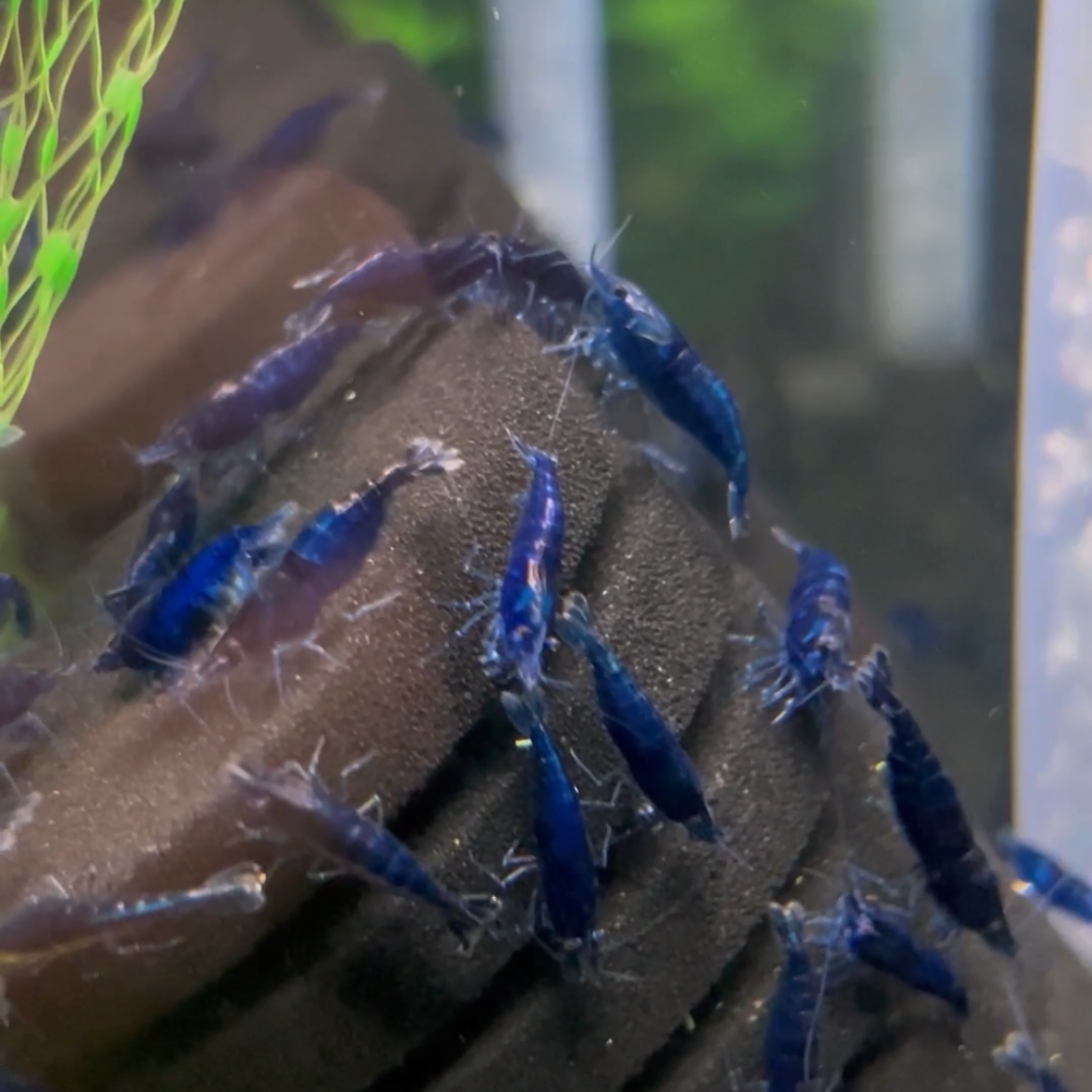
Will Red Cherry × Blue Dream Make Purple Shrimp?
Not reliably.
A Red Cherry and Blue Dream cross is not a dependable method for producing a stable purple Neocaridina strain.
The babies inherit combinations of genetic traits controlling pigment production, transport, binding, chromatophores, pattern, and opacity.
Different generations can therefore look very different from one another.
You may see:
- Red offspring
- Blue or blue-gray offspring
- Brownish offspring
- Transparent offspring
- Patchy color
- Unusual intermediate phenotypes
Even if one offspring happens to look purple, that does not mean it will breed true.
What Does “Breed True” Mean?
A color line “breeds true” when selected parents produce offspring that consistently express the desired phenotype generation after generation.
That consistency is created through selective breeding.
A random one-time cross can create an interesting individual without creating a stable line.
To establish a new strain, breeders must:
- Produce the cross.
- Raise the offspring.
- Select individuals showing the desired trait.
- Breed those selected animals.
- Repeat the process across multiple generations.
- Remove offspring that do not match the target.
That is very different from putting a red shrimp and a blue shrimp together and expecting every baby to be purple.
Can Fire Red Cherry Shrimp Breed With Blue Velvet Shrimp?
Yes.
Blue Velvet is another Neocaridina color line, so reproductive compatibility is not the problem.
The problem is line predictability.
Blue Velvet and Blue Dream are themselves maintained as visually different blue strains. Adding Fire Red genetics makes the future colony even less predictable.
If you care about maintaining the distinct color of any of those lines, keep separate aquariums.
Can Red Cherry Shrimp Breed With Green Jade, Orange, or Rili Shrimp?
Yes.
The same rule applies to common Neocaridina color varieties such as:
- Green Jade
- Orange Sunkist
- Orange Rili
- Red Rili
- Carbon Rili
- Snowball
- Black Rose
- Other selectively bred Neocaridina morphs
They can share broadly similar care requirements, but sharing care requirements does not mean they should share a breeding tank when line purity matters.
What Will Mixed Neocaridina Babies Look Like?
This is the part hobbyists often want a precise chart for—and there is no trustworthy chart that can predict every offspring from every color pairing.
The result depends on:
- The genetic origin of each color line
- Which pigment traits are dominant, recessive, additive, or more complex
- Hidden alleles carried by both parents
- Whether either line has been crossed previously
- Selection history
- Which offspring reproduce in later generations
The first generation may still contain attractive colored shrimp.
Over later generations, however, a mixed colony often becomes less uniform. Hobbyists commonly see more muted, translucent, brown, gray, patchy, or wild-type-like animals as multiple color lines continue recombining.
Why Does Wild-Type Color Reappear?
The bright modern colors seen in aquarium Neocaridina were produced by deliberate selection.
Breeders repeatedly chose shrimp expressing desirable colors and removed animals that did not match the target.
When separate selected lines are mixed, the combinations that produced each pure color are disrupted.
That does not mean every first-generation baby instantly becomes brown.
It means the colony is no longer being protected as one controlled color line, so later generations can express a much wider range of ancestral and recombinant traits.
Does Crossbreeding Hurt the Shrimp?
Mixing compatible Neocaridina color morphs is not inherently harmful simply because the colors are different.
A Fire Red female does not become sick because she mates with a Yellow or Blue male.
The main consequence is genetic and visual:
you lose predictability of the color line.
The aquarium still needs the same fundamentals:
- 0 ppm ammonia
- 0 ppm nitrite
- Stable GH and KH
- Stable pH and TDS
- Appropriate temperature
- Mature biological filtration
- Biofilm and grazing surfaces
- Balanced feeding
For the full husbandry foundation, our Phase 1 Red Cherry Shrimp Care Guide for Beginners covers tank setup, feeding, filtration, breeding, and long-term care.
Do Mixed Neocaridina Need Different Water Parameters?
No special “crossbreed water” is required.
The Red Cherry, Yellow Golden Back, Blue Dream, and Blue Velvet lines currently sold by Shrimp Up Aquatics are maintained under the same basic Neocaridina system conditions.
Our current Fire Red systems are around:
- pH: 7.0–7.8
- GH: 7–8 dGH
- KH: 3–4 dKH
- TDS: 200–250 ppm
- Temperature: 65–74°F
- Ammonia: 0 ppm
- Nitrite: 0 ppm
Stable appropriate water matters more than chasing one exact number. Our Phase 1 Red Cherry Shrimp water parameters guide explains the chemistry in detail.
Do Different Colors Need Different Foods?
No.
Fire Red, Yellow, Blue Dream, and other Neocaridina are all omnivorous grazers.
They can share the same basic diet of:
- Mature biofilm
- Microalgae
- Soft algae
- Complete shrimp food
- Botanicals
- Plant material
- Controlled protein sources
Color-specific pigmentation may respond differently to genetics and pigment pathways, but you do not need a “yellow-only” or “blue-only” survival diet.
Our Phase 1 Red Cherry Shrimp feeding guide covers biofilm, supplemental food, carotenoids, protein, and overfeeding.
Should You Mix Neocaridina Colors in One Tank?
It depends entirely on your goal.
Mix Colors if You Want:
- A colorful display
- A Skittles-style aquarium
- Surprise offspring
- No commitment to maintaining a named color line
Keep Colors Separate if You Want:
- Consistent Fire Red offspring
- Consistent Yellow Golden Back offspring
- Consistent Blue Dream offspring
- Predictable grading
- Selective breeding
- Breeder-quality lines
Neither goal is wrong.
The mistake is mixing the colors and then being surprised when the babies do not remain pure.
What Is a Skittles Shrimp Tank?
A Skittles tank intentionally mixes multiple Neocaridina colors for visual variety.
Instead of maintaining one pure red, blue, or yellow strain, the aquarium starts with an assortment.
This is ideal for keepers who care more about a rainbow display than predictable genetics.
If that is your goal, a mixed Neocaridina shrimp pack makes more sense than buying several pure lines and assuming their offspring will remain identical to the parents.
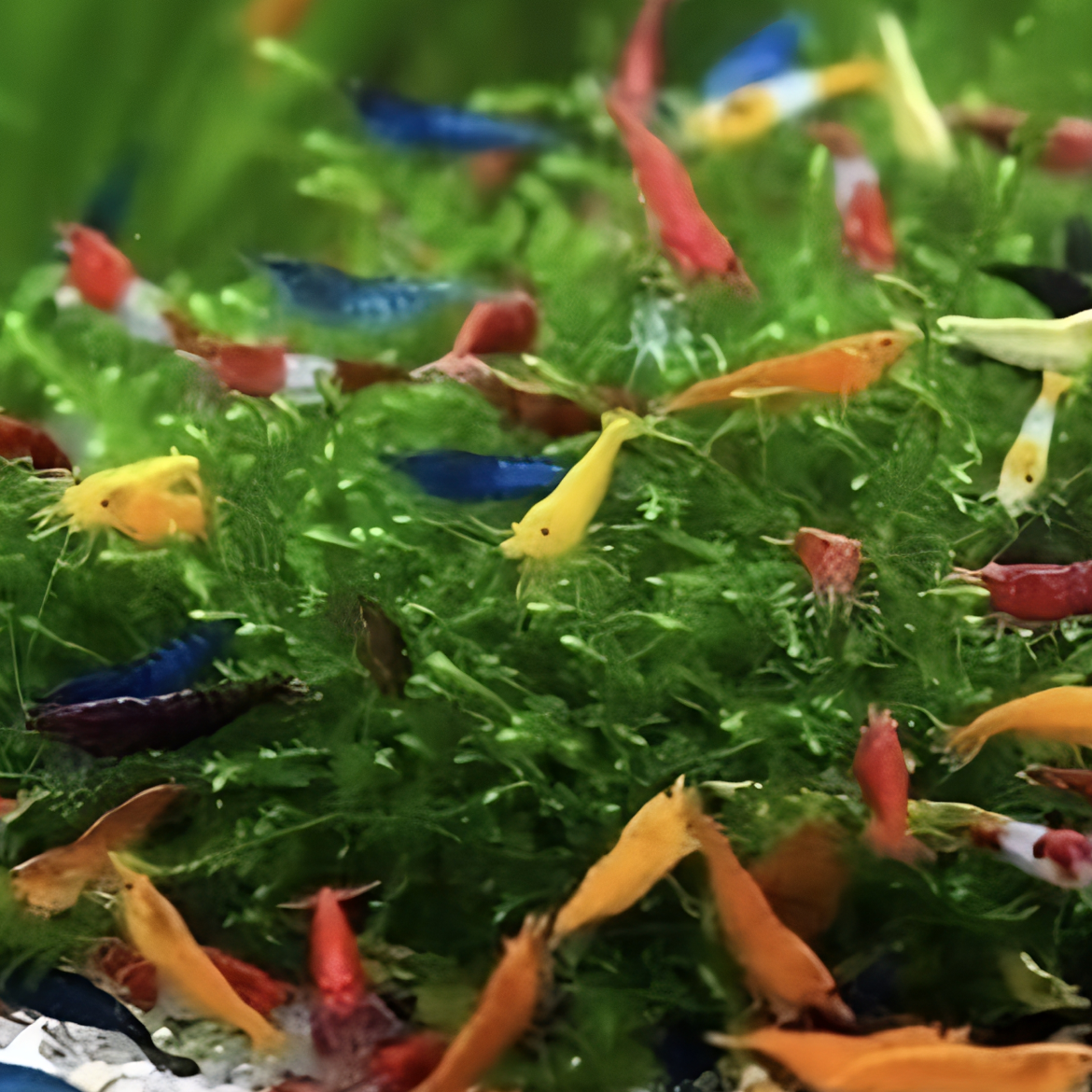
Will a Skittles Colony Stay Rainbow-Colored Forever?
Not necessarily.
The original adults may stay visually diverse because you deliberately started with multiple colors.
Their descendants are different.
As the colors interbreed, later generations can become increasingly unpredictable.
If you want the tank to remain visually colorful, you may eventually need to:
- Add new selected colored shrimp
- Move out brown or clear offspring
- Select particular colors
- Accept the colony as an evolving mixed population
Can You Keep Red and Yellow Together Without Them Breeding?
Only if you prevent opposite-sex mature shrimp from being together.
That is difficult in a normal long-term colony.
If mature males and females are present, assume breeding can eventually occur.
Trying to keep an all-female display is possible in theory, but sexing errors, juveniles, and future additions make it unreliable if line purity is critical.
Can You Keep Red and Blue Together if You Remove Berried Females?
That is not a dependable solution.
By the time a female becomes visibly berried, mating has already happened.
Moving berried females also adds unnecessary stress and creates a constant management burden.
If color purity matters, separate the color lines before breeding occurs.
How Far Apart Do Pure Lines Need to Be?
Separate tanks are enough.
You do not need separate rooms.
However, breeders should pay attention to accidental transfers.
A tiny shrimplet can hitchhike in:
- A net
- A siphon hose
- Plants
- Moss
- Filter media
- Decorations moved between tanks
If you maintain several valuable color lines, use dedicated equipment or inspect shared equipment carefully.
Can a Single Wrong-Color Shrimp Change a Colony?
Potentially, yes.
One mature male from another line can mate with multiple receptive females over time.
One female may also arrive already fertilized or berried.
That does not mean the entire colony instantly changes color, but unwanted genetics can enter the line and appear in later offspring.
What if You Accidentally Added a Blue Shrimp to a Red Colony?
If you notice quickly and line purity matters, remove the wrong-color shrimp.
Then monitor future generations.
If no mating occurred, you may never see an effect.
If mating did occur, mixed traits may appear later.
Do not assume every unusual baby proves the accidental shrimp was responsible—selected lines naturally produce some variation too.
Can You “Undo” a Mixed Neocaridina Colony?
You can improve a mixed colony through selective breeding, but you cannot simply press a reset button.
To rebuild a red line from a mixed population:
- Select the strongest red mature shrimp.
- Move them to a dedicated tank.
- Breed them separately.
- Raise the offspring.
- Select the best red animals again.
- Repeat across generations.
Depending on how mixed the genetics are, starting with a new established Fire Red line may be much faster.
If you want that cleaner starting point, you can buy Red Cherry Shrimp online in several pack sizes or choose the breeder pack for a planned female-heavy starting group.
Can Mixed-Color Females Still Become Berried?
Absolutely.
Crossbreeding does not change the basic reproductive cycle.
A receptive Yellow female can become berried after mating with a Red male. A Blue female can become berried after mating with a Red male.
The egg-carrying period looks essentially like any other Neocaridina brood.
What About Acclimating Different Colors Into the Same Tank?
The colors do not need different acclimation methods, but every new shrimp still needs a careful transition into the destination water.
If you intentionally build a mixed colony, acclimate each shipment according to the actual difference between shipping water and tank water.
Our exact Phase 1 Red Cherry Shrimp acclimation guide explains gradual temperature and water-chemistry adjustment.
Best Substrate for a Mixed Red, Yellow, and Blue Shrimp Tank
If your goal is visual variety rather than pure-line breeding, choose substrate for stability and contrast.
Dark inert substrate is especially useful because:
- Yellow shrimp stand out clearly.
- Red shrimp create strong contrast.
- Many blue shrimp remain visible.
- Inert material keeps water chemistry predictable.
Our Phase 1 Red Cherry Shrimp substrate guide compares inert sand, gravel, and active aquasoil.
Red Cherry × Yellow or Blue Neocaridina FAQ
Can Red Cherry Shrimp breed with Yellow Shrimp?
Yes. Fire Red Cherry and Yellow Golden Back Shrimp are compatible Neocaridina color lines and can breed when mature males and females are housed together.
Can Red Cherry Shrimp breed with Blue Dream Shrimp?
Yes. Blue Dream and Fire Red Cherry Shrimp can interbreed.
Can Red Cherry Shrimp breed with Blue Velvet?
Yes. The same rule applies to Blue Velvet and other common Neocaridina color morphs.
Will Red Cherry and Yellow Shrimp make orange babies?
Not predictably. Color inheritance involves multiple pigment pathways and genetic traits, so red plus yellow cannot be treated like mixing paint.
Will Red Cherry and Blue Dream make purple babies?
Not reliably. A particular offspring may show an unusual intermediate color, but Red × Blue is not a guaranteed way to create a stable purple strain.
Will mixed Neocaridina eventually turn brown?
Mixed colonies often produce increasingly variable offspring over generations, including muted, translucent, brown, gray, patchy, and wild-type-like phenotypes. It is not guaranteed that every baby will become brown immediately.
Are mixed-color Neocaridina unhealthy?
No. Crossing compatible color morphs is mainly a concern for color-line predictability, not automatically animal health.
Do different Neocaridina colors need different water?
No. Common Red, Yellow, Blue, Green, Orange, and Rili Neocaridina have broadly overlapping care requirements. Stable appropriate water is more important than color.
Should I keep every Neocaridina color in a separate tank?
Only if you want each line to breed true. For an intentional mixed display, different colors can live together peacefully.
What is a Skittles Shrimp colony?
It is an intentionally mixed Neocaridina colony containing multiple colors and patterns. The adult display is colorful, while future offspring are allowed to be genetically unpredictable.
Can I restore a pure red line after mixing colors?
Yes, through repeated selective breeding, but it may take many generations. Starting with an established Fire Red line can be faster.
Can different color females carry mixed-color eggs?
Egg color does not tell you exactly what adult color the babies will become. The offspring phenotype develops from inherited genetics as the juveniles grow.
Final Verdict: Mix for Variety, Separate for Line Purity
Red Cherry Shrimp absolutely can interbreed with Yellow Golden Back, Blue Dream, Blue Velvet, Green Jade, Orange, Rili, and other Neocaridina color morphs.
The important decision is not whether they can breed.
It is whether you want them to.
If your goal is a pure Fire Red colony, keep the reds separate.
If your goal is a pure Yellow Golden Back colony, keep the yellows separate.
If your goal is a pure Blue Dream colony, keep the blues separate.
If your goal is a fun rainbow aquarium where every new generation is part of the surprise, an intentional mixed colony can be a great setup.
Just remember:
Neocaridina genetics are not paint mixing. Red + yellow does not equal guaranteed orange. Red + blue does not equal guaranteed purple. Mixed lines create genetic variability, not a predictable color recipe.
For a dedicated red colony, shop Fire Red Cherry Shrimp for sale.
If you prefer an intentional rainbow display, browse the Neocaridina Skittles Shrimp option instead.
Sources & References
Integrative Taxonomy Reveals New Insights into the Species Validity of the Neocaridina davidi–N. denticulata–N. heteropoda Complex — Peer-reviewed integrative taxonomy research combining morphology and molecular data. The authors discuss the very close relationships within this Neocaridina complex and note frequent crossbreeding of ornamental Neocaridina to produce color forms.
Decoding color variation: genome-wide characterization and expression analysis of pigment pathways in Neocaridina denticulata — Recent research directly comparing red, yellow, and blue Neocaridina strains and finding strain-specific differences across carotenoid, pteridine, and melanin-related pigment pathways, illustrating why color inheritance is more complicated than visually blending parent colors.